The number that shapes your experience in a radiofrequency (RF) treatment is not the maximum power printed on the machine. It is how that energy is metered out — how quickly it enters, how the surface is cooled while deeper layers heat, and whether the device adjusts to your skin rather than to a fixed setting. That is what radiofrequency heat control means in practice. This article describes how it works on the Density device used at 4ever the Cheongdam, what the Korean approval for that device covers, and what to tell your doctor before treatment.
What produces the heat, and how does the device know how much to send?
The device does not send heat into you. It sends an alternating current, and the heat is produced inside your own tissue by that tissue’s resistance to the current.
The manufacturer describes Density as delivering a 6.78 MHz high-frequency current to the skin, where electrical resistance generates heat and coagulates tissue (Jeisys Medical, as reported). Two consequences follow from this, and both matter more than the wattage figure:
- Because the heat is generated by resistance, tissue that resists differently heats differently. Two people receiving identical settings do not receive identical heat.
- Resistance is not constant across one face. It changes with skin thickness, water content, and the depth of the layer the current is passing through.
- The energy path depends on the electrode arrangement. The manufacturer states that monopolar delivery reaches deeper skin layers, while bipolar delivery targets shallower ones (Jeisys Medical).
- The company describes its sequential heating technology as delivering both modes, with a maximum output of 400 W (Jeisys Medical).
Because resistance varies, the device reads it before each delivery rather than working to a fixed setting. The manufacturer calls this real-time impedance calibration and describes it as a three-step cycle repeated through the treatment: it reads the impedance, checks that reading against the skin condition, then delivers the shot at a power adjusted to what it found (Jeisys Medical).
What this does not do is remove clinical judgment. Impedance feedback adjusts within a range that a person sets. It does not decide whether you should be treated, at what level, or in which areas. So the useful question is not how much energy a device can produce, but what is done with that energy while it is being produced — and that part stays with your doctor.
What does Korea’s approval for this device cover?
In Korea, Density is approved by the Ministry of Food and Drug Safety (MFDS) as a general electrosurgical unit — a device that uses high-frequency current for coagulation of tissue.
This is worth stating plainly, because it sets the boundary of what can honestly be claimed. The manufacturer’s own approved advertising in Korea carries this line at the foot of its product page: a general electrosurgical unit that uses high-frequency current for coagulation of tissue, with an advertising review number and expiry date printed alongside it (Jeisys Medical).
- Korean approvals for the Density platform sit in the general electrosurgical unit category, class 3. Some approvals in this family also cover non-invasive treatment of wrinkles around the eyes and on the face.
- An approval permits the device to be imported or manufactured and sold for a stated purpose. It is not an approval of any particular treatment outcome.
- You can look up any Korean medical device approval yourself at the MFDS device portal. Search by the approval number rather than the brand name — brand names live in the model field, not the item-name field, so a brand search often returns nothing.
- Where an approval has been withdrawn, it is no longer a basis for anything. Earlier approval is not current approval.
We describe the mechanism in this article. We do not claim lifting, ligament reinforcement, or a duration of effect, because those statements are not in the approved purpose.
How is the surface of your skin protected while deeper tissue heats?
By cooling the surface on a separate channel from the energy, so that the two can be adjusted independently.
Heating deeper tissue while leaving the outermost layer alone is the central problem of every energy-based device. Warm the surface too much and you have a burn; cool it too much and the energy never reaches depth. The manufacturer documents three elements addressing this (Jeisys Medical):
- A five-level adjustable cooling system, described by the company as adjustable to skin type rather than fixed for everyone.
- Gas cooling applied to protect the epidermis, delivered in coordination with the energy pulse rather than after it.
- Real-time skin temperature monitoring, shown on the handpiece display along with pulse count and progress.
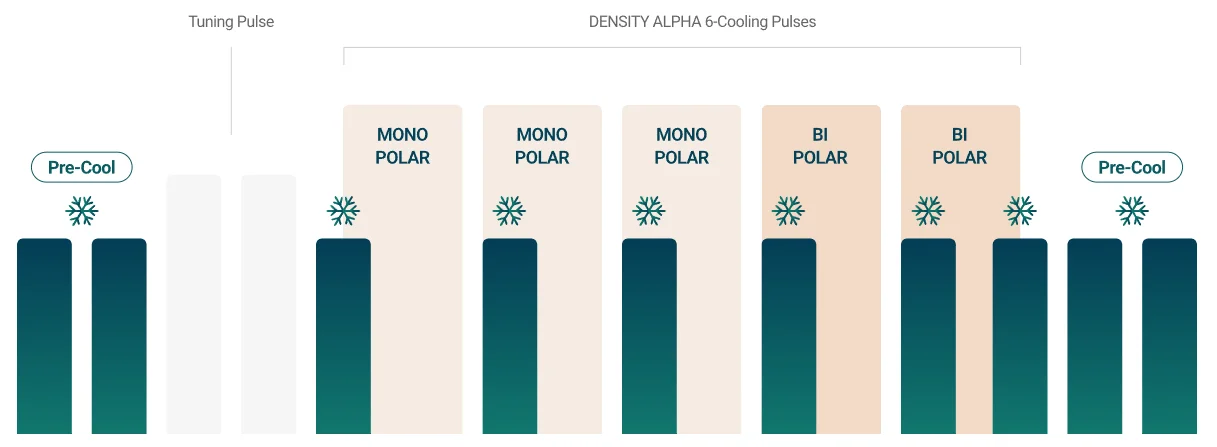
The practical meaning for you is that cooling is a setting your doctor chooses, not a fixed property of the machine. If your skin is thin, or the area is one you know to be sensitive, that is information your doctor can act on before the first pulse rather than after it.
What does it feel like, and why does one area differ from another?
The sensation is usually described as brief heat at the moment each pulse is delivered, rather than a continuous burning. How strong it feels varies between individuals, and between areas of the same face.
The manufacturer states that cooling adjusted to skin temperature after each shot is intended to minimize discomfort (Jeisys Medical). Beyond that, a few things are worth knowing in advance:
- Areas where skin sits close to bone, or where tissue is thinner, are commonly reported as more noticeable than areas with more cushioning.
- Sensitivity to heat differs widely between people and is not predictable from skin type alone.
- If you know you are sensitive to pain or heat, say so before the treatment begins rather than during it. Cooling level and energy level can both be set in advance.
- Tell your doctor if you have had treatment in the same area recently, whatever the device.
What is a single-use tip, and how can you check yours?
A tip is the disposable part that touches your skin and carries the electrodes. The manufacturer states that a genuine Density tip is single-use, intended for one person only, and asks patients to check the authenticity label and number (Jeisys Medical).
This is one of the few things in a treatment room you can verify with your own eyes, which makes it useful if you are being treated in a country you do not live in.
- Tips are not sold as standalone devices. Korean reporting on the original approval describes the main unit and three tips as approved together as one manufacturing item on 5 April 2023 (Medifonews).
- The manufacturer lists several tips intended for different treatment areas, with different contact sizes and shot counts (Jeisys Medical).
- Tips differ in how they deliver energy. The manufacturer describes the classic tip as monopolar, the alpha and high tips as carrying both monopolar and bipolar delivery, and a boost tip as bipolar only (Bosa).
- Which tip suits your treatment is a clinical decision, not a product to request by name.
What to know about side effects
Redness and a sensation of warmth in the treated area are commonly reported after radiofrequency treatment. Because the mechanism is heat generated inside tissue, the reactions to watch for are thermal ones.
| What may occur | What it reflects | What to do |
|---|
| Redness, warmth in the treated area | Normal thermal response | Tell the clinic if it does not settle as expected |
| Swelling or tenderness | Tissue response to heating | Report any increase rather than any decrease |
| Blistering, or a mark that darkens | Possible localized burn | Contact the clinic promptly, do not treat it yourself |
| Sensation change that persists | Requires assessment | Contact the clinic |
Tell the clinic before treatment about:
- any medication you take, including anything taken only occasionally
- any device or injectable treatment you have had in the same area, and when
- any implanted electronic device
- whether you are pregnant, or think you may be
Heat-based treatment is not appropriate for everyone, and the assessment that decides this is a clinical one your doctor makes after examining you.
What this article does not decide
This article describes how heat is produced and controlled in a radiofrequency treatment, and what the Korean approval for this device covers. It does not assess whether this treatment suits you, which settings are appropriate for your skin, or what result you would see. It is not a substitute for a consultation.
Frequently asked questions
Is a higher wattage better?
No conclusion of that kind can be drawn from the number alone. Maximum output describes what a device is capable of producing, not what is delivered to your skin during your treatment. Delivered energy is set by your doctor and adjusted by the device according to the tissue it reads.
Why does the manufacturer describe the device as an electrosurgical unit rather than a lifting device?
Because that is the category the device is approved in. Korean medical device approvals state a specific purpose, and advertising in Korea is expected to stay inside that statement. The manufacturer’s own approved advertising uses the coagulation-of-tissue wording.
Can I ask which tip will be used on me?
Yes, and you can also ask to see the authenticity label before the tip is opened. The manufacturer states that genuine tips are single-use and carry an authenticity number. Which tip is appropriate for your treatment is decided by your doctor.
Does the cooling mean I will feel nothing?
No. Cooling protects the surface of the skin; it does not remove the sensation of heat at depth. The manufacturer describes cooling as intended to minimize discomfort. Individual experience varies, and telling the clinic about heat sensitivity in advance is more useful than enduring it during the session.
How do I check a Korean device approval myself?
Approvals are searchable at the MFDS medical device portal. Search using the approval number in its original Korean form rather than transliterating it — prefixes indicate the approval type, with 제허 meaning a manufacturing approval and 수허 an import approval. Searching a brand name usually returns nothing, because brand names are recorded in the model field.
This article is general information about a treatment offered at 4ever the Cheongdam. It is not medical advice and does not replace consultation with a doctor who has examined you. Product approvals, regulations, and clinic practices change; please confirm anything that affects a decision with the clinic directly.
4ever the Cheongdam
99-23 Cheongdam-dong, Gangnam-gu, Seoul, Korea
서울 강남구 청담동 99-23 (copy this line into Naver Map, Kakao Map, or show it to a taxi driver)
Tel. +82-2-518-7705

The number that shapes your experience in a radiofrequency (RF) treatment is not the maximum power printed on the machine. It is how that energy is metered out — how quickly it enters, how the surface is cooled while deeper layers heat, and whether the device adjusts to your skin rather than to a fixed setting. That is what radiofrequency heat control means in practice. This article describes how it works on the Density device used at 4ever the Cheongdam, what the Korean approval for that device covers, and what to tell your doctor before treatment.
What produces the heat, and how does the device know how much to send?
The device does not send heat into you. It sends an alternating current, and the heat is produced inside your own tissue by that tissue’s resistance to the current.
The manufacturer describes Density as delivering a 6.78 MHz high-frequency current to the skin, where electrical resistance generates heat and coagulates tissue (Jeisys Medical, as reported). Two consequences follow from this, and both matter more than the wattage figure:
Because resistance varies, the device reads it before each delivery rather than working to a fixed setting. The manufacturer calls this real-time impedance calibration and describes it as a three-step cycle repeated through the treatment: it reads the impedance, checks that reading against the skin condition, then delivers the shot at a power adjusted to what it found (Jeisys Medical).
What this does not do is remove clinical judgment. Impedance feedback adjusts within a range that a person sets. It does not decide whether you should be treated, at what level, or in which areas. So the useful question is not how much energy a device can produce, but what is done with that energy while it is being produced — and that part stays with your doctor.
What does Korea’s approval for this device cover?
In Korea, Density is approved by the Ministry of Food and Drug Safety (MFDS) as a general electrosurgical unit — a device that uses high-frequency current for coagulation of tissue.
This is worth stating plainly, because it sets the boundary of what can honestly be claimed. The manufacturer’s own approved advertising in Korea carries this line at the foot of its product page: a general electrosurgical unit that uses high-frequency current for coagulation of tissue, with an advertising review number and expiry date printed alongside it (Jeisys Medical).
We describe the mechanism in this article. We do not claim lifting, ligament reinforcement, or a duration of effect, because those statements are not in the approved purpose.
How is the surface of your skin protected while deeper tissue heats?
By cooling the surface on a separate channel from the energy, so that the two can be adjusted independently.
Heating deeper tissue while leaving the outermost layer alone is the central problem of every energy-based device. Warm the surface too much and you have a burn; cool it too much and the energy never reaches depth. The manufacturer documents three elements addressing this (Jeisys Medical):
The practical meaning for you is that cooling is a setting your doctor chooses, not a fixed property of the machine. If your skin is thin, or the area is one you know to be sensitive, that is information your doctor can act on before the first pulse rather than after it.
What does it feel like, and why does one area differ from another?
The sensation is usually described as brief heat at the moment each pulse is delivered, rather than a continuous burning. How strong it feels varies between individuals, and between areas of the same face.
The manufacturer states that cooling adjusted to skin temperature after each shot is intended to minimize discomfort (Jeisys Medical). Beyond that, a few things are worth knowing in advance:
What is a single-use tip, and how can you check yours?
A tip is the disposable part that touches your skin and carries the electrodes. The manufacturer states that a genuine Density tip is single-use, intended for one person only, and asks patients to check the authenticity label and number (Jeisys Medical).
This is one of the few things in a treatment room you can verify with your own eyes, which makes it useful if you are being treated in a country you do not live in.
What to know about side effects
Redness and a sensation of warmth in the treated area are commonly reported after radiofrequency treatment. Because the mechanism is heat generated inside tissue, the reactions to watch for are thermal ones.
Tell the clinic before treatment about:
Heat-based treatment is not appropriate for everyone, and the assessment that decides this is a clinical one your doctor makes after examining you.
What this article does not decide
This article describes how heat is produced and controlled in a radiofrequency treatment, and what the Korean approval for this device covers. It does not assess whether this treatment suits you, which settings are appropriate for your skin, or what result you would see. It is not a substitute for a consultation.
Frequently asked questions
Is a higher wattage better?
No conclusion of that kind can be drawn from the number alone. Maximum output describes what a device is capable of producing, not what is delivered to your skin during your treatment. Delivered energy is set by your doctor and adjusted by the device according to the tissue it reads.
Why does the manufacturer describe the device as an electrosurgical unit rather than a lifting device?
Because that is the category the device is approved in. Korean medical device approvals state a specific purpose, and advertising in Korea is expected to stay inside that statement. The manufacturer’s own approved advertising uses the coagulation-of-tissue wording.
Can I ask which tip will be used on me?
Yes, and you can also ask to see the authenticity label before the tip is opened. The manufacturer states that genuine tips are single-use and carry an authenticity number. Which tip is appropriate for your treatment is decided by your doctor.
Does the cooling mean I will feel nothing?
No. Cooling protects the surface of the skin; it does not remove the sensation of heat at depth. The manufacturer describes cooling as intended to minimize discomfort. Individual experience varies, and telling the clinic about heat sensitivity in advance is more useful than enduring it during the session.
How do I check a Korean device approval myself?
Approvals are searchable at the MFDS medical device portal. Search using the approval number in its original Korean form rather than transliterating it — prefixes indicate the approval type, with 제허 meaning a manufacturing approval and 수허 an import approval. Searching a brand name usually returns nothing, because brand names are recorded in the model field.
This article is general information about a treatment offered at 4ever the Cheongdam. It is not medical advice and does not replace consultation with a doctor who has examined you. Product approvals, regulations, and clinic practices change; please confirm anything that affects a decision with the clinic directly.
4ever the Cheongdam
99-23 Cheongdam-dong, Gangnam-gu, Seoul, Korea
서울 강남구 청담동 99-23 (copy this line into Naver Map, Kakao Map, or show it to a taxi driver)
Tel. +82-2-518-7705