A Celexo toner on your bathroom shelf and the Celexo exosome skin booster used at 4ever the Cheongdam come from the same brand and the same plant, but they are not two sizes of one product. The toner and serum are cosmetics you apply yourself, every day, on intact skin. The skin booster is a vial that the clinic applies, usually together with a device that makes fine channels in the skin, on a schedule the doctor sets around your other treatments. This article explains those differences in form, delivery, and timing, what we could and could not confirm about Celexo’s approval status in Korea, and what to plan for if you are coming from abroad.
What is Celexo, and what does “plant-derived exosome” mean?
Celexo is a Korean brand of plant-derived exosome products developed by ABio materials (주식회사 에이바이오머티리얼즈). Its raw material is Centella asiatica, the plant behind many “cica” creams. On its company website, the manufacturer states that it grows its own Centella variety, which it calls HOIN, in a smart-farm environment, and names the exosome material made from it Exo-Cica®.
Exosomes are very small particles that cells release when they exchange signals with other cells. You can think of them as envelopes that carry a message from one cell to the next. Exosome ingredients in skin care generally fall into two groups by source:
- Human-derived, obtained from cultured human stem cells
- Plant-derived, obtained from plants such as Centella asiatica
- Celexo belongs to the plant-derived group
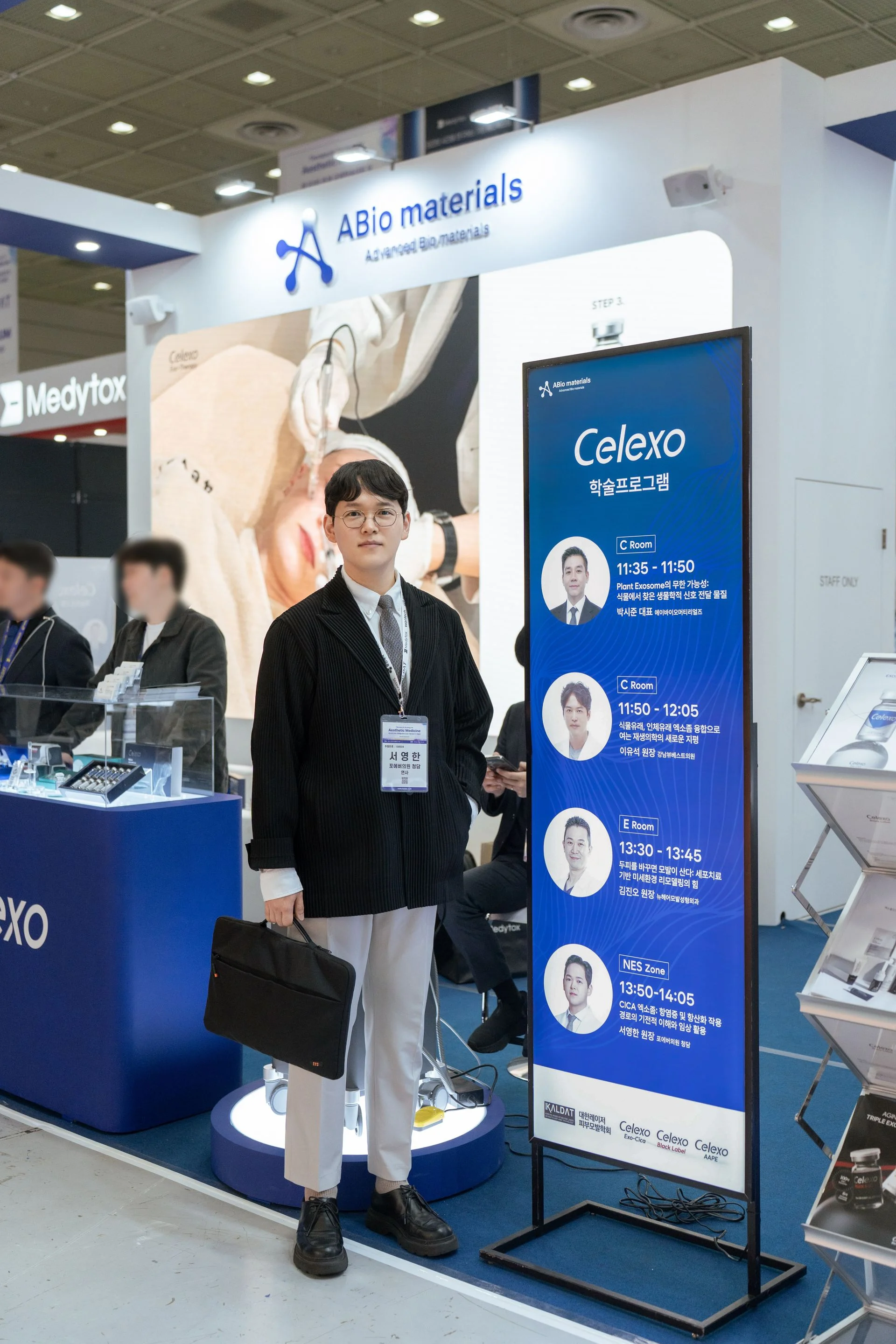
Dr. Younghan Seo, who uses the ingredient in the clinic, visited the smart farm where the manufacturer grows its raw material, to see the production process in person.
One more point matters for everything below: “Celexo” is not a single product. It is a family of about ten products, and they do not all share the same regulatory category. The name “Exo-Cica” also appears in more than one place: on the clinic booster, and on the manufacturer’s home-care line. When this article says “Celexo,” it names which item it means.
How are Celexo toners and serums used at home?
At home, you apply the product yourself, on skin that has not been opened by any device, as part of your daily routine. That is the whole of it, and it is a real difference rather than a small one.
- Form: toner and serum, in ordinary cosmetic bottles
- Who applies it: you
- When: morning and evening, as part of your usual routine
- Where it goes: onto the skin surface, the way any cosmetic does
- What to watch for: stinging, itching, or redness after use, which is a reason to stop and ask a doctor
According to a news report on the launch, the manufacturer sells its home products under a separate cosmetics brand, Celexo Cosmetics, and its first line is also called Exo-Cica. So a toner labeled “Exo-Cica” and the clinic vial share a name, but not a format or a way of use. We have not checked these products in Korea’s cosmetics database, which requires separate access, so we describe them only as the manufacturer presents them.
Home care is steady, low-intensity upkeep. It fits into the days between clinic visits. It does not replace a clinical decision about your skin, and it is not the same thing as the in-clinic booster described next.
How is the in-clinic exosome skin booster used?
The in-clinic booster differs from home care in three ways: what is in the vial, how it reaches the skin, and when it is used. None of these three describes a treatment result. They describe the procedure.
What is in the vial. The booster used at the clinic is Celexo Exo-Cica, supplied in vials. On its product page, the manufacturer lists three components: its Centella exosome material (Exo-Cica®), a dual-structure hyaluronic acid that combines high- and low-molecular-weight forms, and collagen types I and III. This is the manufacturer’s description; we have not seen an independent source for the composition.
How it reaches the skin. At home, the product stays on the surface. In the clinic, a device first creates very fine channels, and the solution is applied through them. The devices the clinic uses for this include:
- MTS (microneedle therapy system), a handpiece with fine needles
- The Potenza pumping tip, an RF microneedle tip designed to push solution into the channels it makes
- Other delivery devices, chosen by the doctor for your skin
- For more on these delivery methods, see our earlier article on skin booster delivery methods
When it is used. The clinic schedules booster sessions around other care rather than as a daily habit. The Korean source article describes the clinic using it after laser, needle RF, and lifting procedures, during the period when the skin is recovering. Whether a session belongs in your plan, and when, is decided at the consultation.
How often. At the clinic, sessions are usually scheduled two to three weeks apart, for three sessions or more. Your own schedule may differ, depending on your skin and your other treatments.
The simplest way to picture it: home care is a daily walk, and the clinic booster is an appointment on the calendar. Both involve the same brand, but they are planned differently and done by different hands.
What is confirmed about Celexo’s approval status in Korea?
We could not link Celexo Exo-Cica, the booster used at the clinic, to a specific Korean medical device approval. Because of that, this article does not describe what the booster does to the skin. It describes only how it is used.
Here is what we checked in the records of Korea’s Ministry of Food and Drug Safety (MFDS):
- The manufacturer holds three medical device approvals in Korea under its company name
- One is an injectable tissue-repair material (class 4)
- Two are adhesive transparent wound dressings (class 2)
- The approval records list products by model codes, not by brand names, so none of the Celexo product names appear in them
- The name “Exo-Cica” does not appear in any of the three records, so we cannot say which approval, if any, corresponds to it
We have not confirmed any FDA or CE approval for Celexo products, and we do not describe one.
If you want to check a product yourself, ask the clinic for the approval number printed on the package. Korean approval numbers are written in Korean, such as 제허 (manufacturing approval) or 수허 (import approval), followed by digits. Search the number exactly as written on the MFDS medical device portal. Keep in mind that a device approval allows a product to be sold for a stated purpose. It is not an approval of any particular treatment outcome.
What should you plan for if you are visiting from abroad?
A booster course is spread over several weeks, so the first thing to plan is time. If your stay in Seoul is short, raise this at the consultation rather than on the day of treatment.
- Length of stay: sessions two to three weeks apart do not fit into a single short visit. Ask the doctor what makes sense if you can come only once, or only occasionally
- Your current products: bring a list of what you use at home, with ingredient names in English or a photo of each label
- Your medications: bring the names and doses of any medicines and supplements you take
- Language: confirm in advance which language the consultation will be held in, so you can ask your questions clearly
- Aftercare timing: ask when you can wear makeup, use sunscreen, or return to your home products, and write it down
If you plan to take Celexo home-care products back with you, check your airline’s liquid rules for carry-on luggage and your own country’s rules on bringing in cosmetics. These differ by country and by airport.
Before you continue any home products after a clinic session, ask the clinic. Skin that has just had channels made in it is not in the same condition as skin at the end of an ordinary day.
What side effects and precautions should you know about?
Most of what people notice after an in-clinic booster session comes from the delivery step, the device that opens fine channels in the skin. Home products carry a different, milder kind of risk: irritation from something you apply to intact skin.
After microneedle or RF microneedle delivery, the following are commonly reported:
- Redness and a warm feeling in the treated area
- Mild swelling
- Pinpoint bleeding during the procedure, and occasional small bruises
- Dryness or light flaking as the skin settles
- Less often: infection, an allergic reaction to an ingredient, or darkening of the skin after inflammation
| Situation | What to do |
|---|
| Redness or swelling after a session | Follow the aftercare instructions the clinic gives you and avoid touching or scrubbing the area |
| Pain that grows, pus, or fever | Contact the clinic promptly |
| Hives, spreading rash, or trouble breathing | Seek urgent medical care |
| Stinging or itching from a home toner or serum | Stop using it and show the product to a doctor |
| Skin that darkens in the treated area | Tell the clinic; do not treat it yourself |
Tell the clinic before any session if you take blood thinners or acne medicine such as isotretinoin, if you have an active skin infection or cold sores, if you are pregnant or breastfeeding, if you scar easily, or if you have had another procedure on the same area recently. Whether a booster session suits you is a clinical judgment your doctor makes after examining you.
What does this article not decide?
This article describes how Celexo home products and the in-clinic Celexo booster are used, and what is and is not documented about them in Korea. It does not assess whether either one suits your skin, and it is not a substitute for a consultation with a doctor who has examined you.
Frequently asked questions
Can I use a Celexo toner at home instead of the clinic skin booster?
They are not interchangeable. The toner is something you apply to intact skin every day. The booster is applied in the clinic through fine channels made by a device, on a schedule the doctor sets. Which one, both, or neither fits your situation is a decision for the consultation.
Can I go back to my Celexo home products after a booster session?
Ask the clinic before you do. Right after a session, the skin has fine channels in it, and the clinic will tell you when to resume your usual routine, including sunscreen and makeup.
How many sessions will I need?
At the clinic, sessions are usually two to three weeks apart, for three sessions or more. Your number depends on your skin and your other treatments, and the doctor decides it after examining you.
Is the Celexo skin booster approved in Korea?
We could not confirm which Korean approval, if any, covers the booster. The manufacturer holds three medical device approvals, but the records use model codes rather than brand names. Ask the clinic for the approval number on the product if this matters to your decision.
Is Celexo approved by the FDA?
We have not confirmed any FDA or CE approval for Celexo products. Because the treatment takes place in Korea, the Korean approval is the one that applies.
Is a plant-derived exosome the same as a human-derived one?
No. They come from different sources: plant-derived exosomes are obtained from plants such as Centella asiatica, and human-derived exosomes from cultured human cells. This article does not compare the two.
This article is general information about a treatment offered at 4ever the Cheongdam. It is not medical advice and does not replace consultation with a doctor who has examined you. Product approvals, regulations, and clinic practices change; please confirm anything that affects a decision with the clinic directly.
4ever the Cheongdam
99-23 Cheongdam-dong, Gangnam-gu, Seoul, Korea
서울 강남구 청담동 99-23
Tel. +82-2-518-7705
About this article: An AI model (Claude) translated and restructured the clinic’s Korean-language article into English, and a human editor reviewed the draft against Korean medical advertising rules before publication.

A Celexo toner on your bathroom shelf and the Celexo exosome skin booster used at 4ever the Cheongdam come from the same brand and the same plant, but they are not two sizes of one product. The toner and serum are cosmetics you apply yourself, every day, on intact skin. The skin booster is a vial that the clinic applies, usually together with a device that makes fine channels in the skin, on a schedule the doctor sets around your other treatments. This article explains those differences in form, delivery, and timing, what we could and could not confirm about Celexo’s approval status in Korea, and what to plan for if you are coming from abroad.
What is Celexo, and what does “plant-derived exosome” mean?
Celexo is a Korean brand of plant-derived exosome products developed by ABio materials (주식회사 에이바이오머티리얼즈). Its raw material is Centella asiatica, the plant behind many “cica” creams. On its company website, the manufacturer states that it grows its own Centella variety, which it calls HOIN, in a smart-farm environment, and names the exosome material made from it Exo-Cica®.
Exosomes are very small particles that cells release when they exchange signals with other cells. You can think of them as envelopes that carry a message from one cell to the next. Exosome ingredients in skin care generally fall into two groups by source:
Dr. Younghan Seo, who uses the ingredient in the clinic, visited the smart farm where the manufacturer grows its raw material, to see the production process in person.
One more point matters for everything below: “Celexo” is not a single product. It is a family of about ten products, and they do not all share the same regulatory category. The name “Exo-Cica” also appears in more than one place: on the clinic booster, and on the manufacturer’s home-care line. When this article says “Celexo,” it names which item it means.
How are Celexo toners and serums used at home?
At home, you apply the product yourself, on skin that has not been opened by any device, as part of your daily routine. That is the whole of it, and it is a real difference rather than a small one.
According to a news report on the launch, the manufacturer sells its home products under a separate cosmetics brand, Celexo Cosmetics, and its first line is also called Exo-Cica. So a toner labeled “Exo-Cica” and the clinic vial share a name, but not a format or a way of use. We have not checked these products in Korea’s cosmetics database, which requires separate access, so we describe them only as the manufacturer presents them.
Home care is steady, low-intensity upkeep. It fits into the days between clinic visits. It does not replace a clinical decision about your skin, and it is not the same thing as the in-clinic booster described next.
How is the in-clinic exosome skin booster used?
The in-clinic booster differs from home care in three ways: what is in the vial, how it reaches the skin, and when it is used. None of these three describes a treatment result. They describe the procedure.
What is in the vial. The booster used at the clinic is Celexo Exo-Cica, supplied in vials. On its product page, the manufacturer lists three components: its Centella exosome material (Exo-Cica®), a dual-structure hyaluronic acid that combines high- and low-molecular-weight forms, and collagen types I and III. This is the manufacturer’s description; we have not seen an independent source for the composition.
How it reaches the skin. At home, the product stays on the surface. In the clinic, a device first creates very fine channels, and the solution is applied through them. The devices the clinic uses for this include:
When it is used. The clinic schedules booster sessions around other care rather than as a daily habit. The Korean source article describes the clinic using it after laser, needle RF, and lifting procedures, during the period when the skin is recovering. Whether a session belongs in your plan, and when, is decided at the consultation.
How often. At the clinic, sessions are usually scheduled two to three weeks apart, for three sessions or more. Your own schedule may differ, depending on your skin and your other treatments.
The simplest way to picture it: home care is a daily walk, and the clinic booster is an appointment on the calendar. Both involve the same brand, but they are planned differently and done by different hands.
What is confirmed about Celexo’s approval status in Korea?
We could not link Celexo Exo-Cica, the booster used at the clinic, to a specific Korean medical device approval. Because of that, this article does not describe what the booster does to the skin. It describes only how it is used.
Here is what we checked in the records of Korea’s Ministry of Food and Drug Safety (MFDS):
We have not confirmed any FDA or CE approval for Celexo products, and we do not describe one.
If you want to check a product yourself, ask the clinic for the approval number printed on the package. Korean approval numbers are written in Korean, such as 제허 (manufacturing approval) or 수허 (import approval), followed by digits. Search the number exactly as written on the MFDS medical device portal. Keep in mind that a device approval allows a product to be sold for a stated purpose. It is not an approval of any particular treatment outcome.
What should you plan for if you are visiting from abroad?
A booster course is spread over several weeks, so the first thing to plan is time. If your stay in Seoul is short, raise this at the consultation rather than on the day of treatment.
If you plan to take Celexo home-care products back with you, check your airline’s liquid rules for carry-on luggage and your own country’s rules on bringing in cosmetics. These differ by country and by airport.
Before you continue any home products after a clinic session, ask the clinic. Skin that has just had channels made in it is not in the same condition as skin at the end of an ordinary day.
What side effects and precautions should you know about?
Most of what people notice after an in-clinic booster session comes from the delivery step, the device that opens fine channels in the skin. Home products carry a different, milder kind of risk: irritation from something you apply to intact skin.
After microneedle or RF microneedle delivery, the following are commonly reported:
Tell the clinic before any session if you take blood thinners or acne medicine such as isotretinoin, if you have an active skin infection or cold sores, if you are pregnant or breastfeeding, if you scar easily, or if you have had another procedure on the same area recently. Whether a booster session suits you is a clinical judgment your doctor makes after examining you.
What does this article not decide?
This article describes how Celexo home products and the in-clinic Celexo booster are used, and what is and is not documented about them in Korea. It does not assess whether either one suits your skin, and it is not a substitute for a consultation with a doctor who has examined you.
Frequently asked questions
Can I use a Celexo toner at home instead of the clinic skin booster?
They are not interchangeable. The toner is something you apply to intact skin every day. The booster is applied in the clinic through fine channels made by a device, on a schedule the doctor sets. Which one, both, or neither fits your situation is a decision for the consultation.
Can I go back to my Celexo home products after a booster session?
Ask the clinic before you do. Right after a session, the skin has fine channels in it, and the clinic will tell you when to resume your usual routine, including sunscreen and makeup.
How many sessions will I need?
At the clinic, sessions are usually two to three weeks apart, for three sessions or more. Your number depends on your skin and your other treatments, and the doctor decides it after examining you.
Is the Celexo skin booster approved in Korea?
We could not confirm which Korean approval, if any, covers the booster. The manufacturer holds three medical device approvals, but the records use model codes rather than brand names. Ask the clinic for the approval number on the product if this matters to your decision.
Is Celexo approved by the FDA?
We have not confirmed any FDA or CE approval for Celexo products. Because the treatment takes place in Korea, the Korean approval is the one that applies.
Is a plant-derived exosome the same as a human-derived one?
No. They come from different sources: plant-derived exosomes are obtained from plants such as Centella asiatica, and human-derived exosomes from cultured human cells. This article does not compare the two.
This article is general information about a treatment offered at 4ever the Cheongdam. It is not medical advice and does not replace consultation with a doctor who has examined you. Product approvals, regulations, and clinic practices change; please confirm anything that affects a decision with the clinic directly.
4ever the Cheongdam
99-23 Cheongdam-dong, Gangnam-gu, Seoul, Korea
서울 강남구 청담동 99-23
Tel. +82-2-518-7705
About this article: An AI model (Claude) translated and restructured the clinic’s Korean-language article into English, and a human editor reviewed the draft against Korean medical advertising rules before publication.