Density and Thermage are both radiofrequency (RF) devices that heat the deeper layers of the skin while cooling the surface, and in Korea both are approved in the same device category with closely matching wording: non-invasive treatment of wrinkles around the eyes and on the face. Thermage has been in use for longer and is the better-known name outside Korea; Density is made by a Korean manufacturer, Jeisys Medical. The two manufacturers describe different ways of delivering the energy, and those differences are what this article explains. Which device, if either, is used for you is decided at the consultation.
What do Density and Thermage have in common?
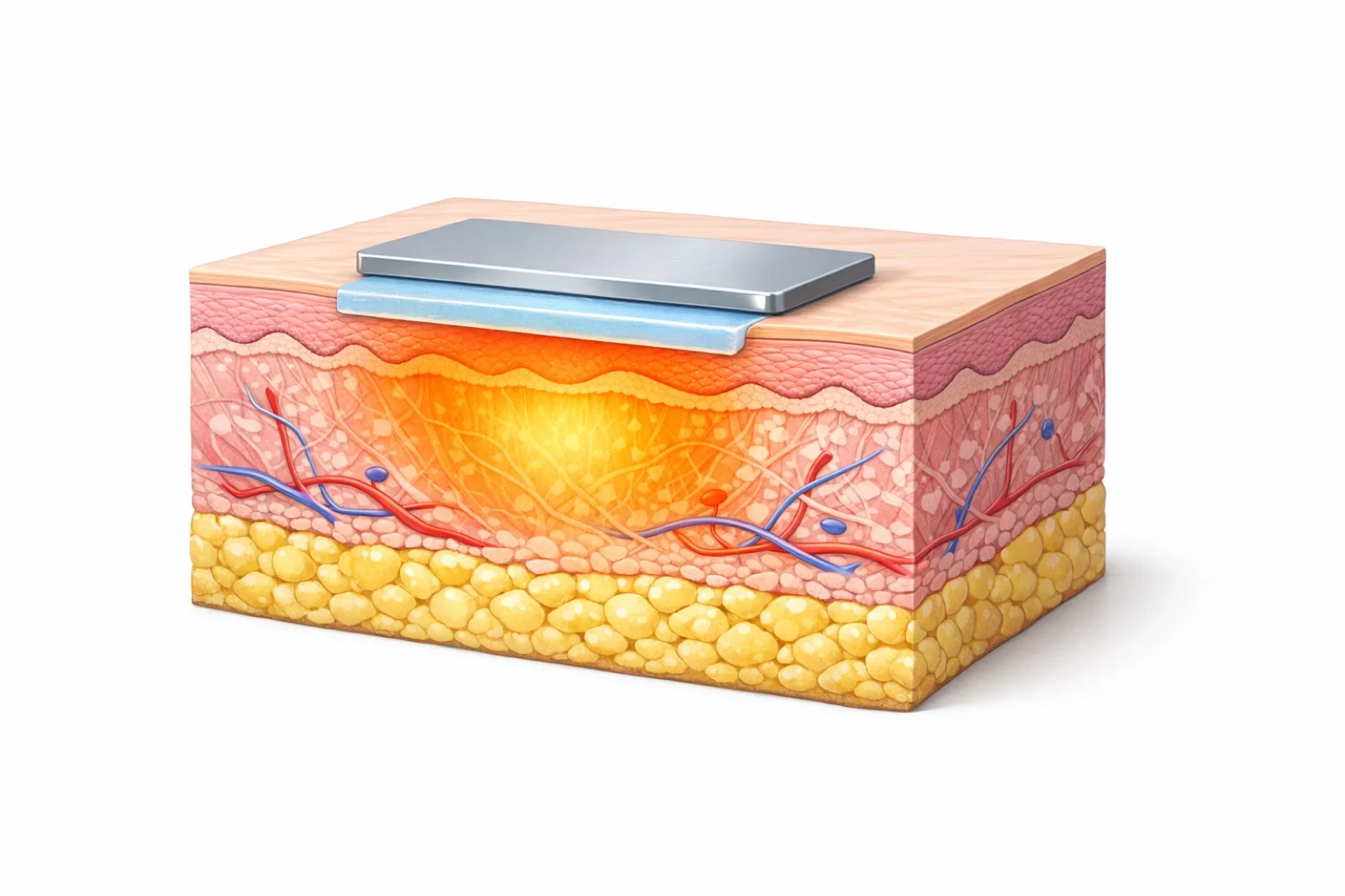
Both devices pass a radiofrequency current into the skin, and the tissue’s resistance to that current produces heat. Neither device sends heat in from outside; the heat is generated inside the tissue.
 Both are approved in Korea as general electrosurgical units, class 3.
- The approvals for Thermage FLX and for Density System and Density Noir use the same purpose wording: non-invasive treatment of wrinkles around the eyes and on the face.
- Both cool the skin surface while the deeper layers heat, so that the outermost layer is protected.
- Both use disposable tips that touch the skin, and both manufacturers describe their tips as single-use, for a single person.
How heat is produced and controlled in an RF treatment is covered in more detail in an earlier article on heat control.
How does Thermage work, as its manufacturer describes it?
Thermage FLX delivers monopolar radiofrequency energy through a handpiece that combines heating with cooling and vibration, according to its manufacturer, Solta Medical (Thermage).
- Monopolar RF. The current passes from the treatment tip into the body, which reaches the deeper layers of the skin.
- Cooling during each pulse. The manufacturer describes a brief heating sensation when the tip touches the skin, followed by cooling to protect the surface.
- Vibration. The handpiece adds vibration, which the manufacturer says is intended to help with comfort.
- Tips with a fixed pulse count. Tips come in different sizes for different areas, including a smaller tip for around the eyes. Once a tip has delivered its pulses to a patient, it cannot be used again.
In Korea, the device approved as Thermage FLX is listed under the model name TG-3A and imported by Solta Medical Korea.
How does Density work, as its manufacturer describes it?
Density delivers monopolar and bipolar radiofrequency energy in sequence and adjusts its output to the skin it reads, according to its manufacturer, Jeisys Medical (Jeisys Medical).
- Two kinds of RF in sequence. The manufacturer describes a patented sequential heating technology that combines monopolar RF, for deeper layers, with bipolar RF, for shallower layers.
- Impedance feedback. Before each shot, the device reads the skin’s electrical resistance, checks it, and then delivers energy at an adjusted power. The manufacturer calls this real-time impedance calibration.
- Five cooling levels. Gas cooling protects the surface, with five adjustable levels and real-time skin temperature monitoring.
- Several tip types. The manufacturer lists a classic tip (monopolar only) and high and alpha tips (monopolar and bipolar). Genuine tips are single-use, for a single person only.
The manufacturer states a maximum output of 400 W. That figure describes what the device can produce, not what is delivered in a treatment; the energy used for you is set by the doctor and adjusted by the device as it reads your skin. More on the tips is in an earlier article on the Density alpha tip.
What do the Korean approvals say for each device?
The approval wording is close across the two brands. The table lists the current records from the Korean Ministry of Food and Drug Safety (MFDS) device register, retrieved on 1 October 2026. It shows approval wording only and does not rank the devices.
| Device | Approval no. | Category | Approved purpose in Korea (translated) |
|---|
| Thermage FLX (TG-3A) | 수허 18-245 | General electrosurgical unit, class 3 | Coagulating tissue with high-frequency current for non-invasive treatment of wrinkles around the eyes and on the face |
| Density System | 제허 23-63 | General electrosurgical unit, class 3 | Coagulating tissue with high-frequency current for non-invasive treatment of wrinkles around the eyes and on the face |
| Density Noir | 제허 24-114 | General electrosurgical unit, class 3 | Coagulating tissue with high-frequency current for non-invasive treatment of wrinkles around the eyes and on the face |
| Density Noir (K) | 제허 23-472 | General electrosurgical unit, class 3 | Coagulating tissue with high-frequency current |
- The Density name covers more than one record, and one of them, Density Noir (K), is approved for tissue coagulation without naming wrinkles. If you want to know which record applies to the device used on you, ask the clinic for the approval number on the device label.
- Each approval names a purpose. It is not an approval of any particular result for any one person.
- You can look up any record yourself at emedi.mfds.go.kr by approval number.
What does the examination look at, and what should a visitor from abroad plan for?
The doctor is matching the device, the tip, and the energy to your skin, not choosing a brand. A consultation for an RF treatment is likely to cover the points below.
- Where the change is. Fine lines around the eyes and laxity along the lower face are different questions, and tips differ by area.
- Skin thickness. Thin skin and thicker skin respond differently to the same energy, which affects tip choice and settings.
- Volume. RF heats tissue; it does not add volume. Where volume has been lost, other approaches may be discussed alongside or instead.
- Sensitivity to heat. Some people find the sensation stronger than others; cooling and energy levels can be set with that in mind.
- Recent procedures. Fillers, threads, or other energy treatments in the same area affect timing.
Whether either device suits you is a clinical judgment your doctor makes after examining you.
If you are visiting from abroad, plan for the consultation as much as the session. An RF session is usually a single visit, but the clinic may want to see you again, and there are a few things worth settling before you travel.
- Know which device you are booking. Device names are used loosely in marketing. Ask which device and which tip will be used, and the approval number on the device label if you want a record.
- Check the tip. Both manufacturers describe their tips as single-use. You can ask to see the tip and its packaging before treatment.
- Leave time after the session. Redness and a feeling of warmth usually settle as the skin recovers, but plan the day around it rather than flying immediately afterward.
- Follow-up. Ask when the clinic would like to see you again, and whether photographs can be sent instead if you have left Korea.
What are the side effects, and what should you watch for?
Redness and a sensation of warmth in the treated area are commonly reported after RF treatments. Because the heat is generated inside the tissue, the reactions to watch for are thermal ones. The clinic’s written instructions take precedence.
| Commonly reported | What clinics commonly instruct |
|---|
| Redness and warmth in the treated area | Follow the aftercare sheet; avoid heat, saunas, and intense exercise for the period the clinic sets |
| Mild swelling or tenderness | Tell the clinic if it increases instead of settling |
| Blistering, or a mark that darkens | Contact the clinic promptly; do not treat it yourself |
| Numbness or a change in sensation that persists | Contact the clinic |
Tell the clinic before treatment about any medication you take, any implanted electronic device, any metal implants in the treatment area, whether you are pregnant, and any device or injectable treatment in the same area. Whether this treatment suits you is a clinical judgment your doctor makes after examining you.
FAQ
Are Density and Thermage the same kind of device?
Both are radiofrequency devices approved in Korea as general electrosurgical units, class 3. Thermage FLX uses monopolar RF; Density, according to its manufacturer, delivers monopolar and bipolar RF in sequence.
Does the higher maximum output mean a stronger treatment?
No conclusion of that kind can be drawn from the number. Maximum output describes what a device can produce, not what is delivered to your skin. The energy used for you is set by the doctor.
Is Density approved in Korea for wrinkles?
Density System and Density Noir are approved for non-invasive treatment of wrinkles around the eyes and on the face. Another record, Density Noir (K), is approved for tissue coagulation without naming wrinkles. Ask for the approval number on the device used on you.
How many sessions are needed?
That depends on the device, the area, and your skin, and the doctor decides it after examining you. Ask at the consultation how the clinic plans sessions for your case.
Can I see the treatment tip before my session?
Yes, you can ask. Both manufacturers describe their tips as single-use, and the tip packaging is something you can check yourself.
This article is general information about a treatment offered at 4ever the Cheongdam. It is not medical advice and does not replace consultation with a doctor who has examined you. Product approvals, regulations, and clinic practices change; please confirm anything that affects a decision with the clinic directly.
Sources: Korean Ministry of Food and Drug Safety, medical device register, emedi.mfds.go.kr (records 수허 18-245, 제허 23-63, 제허 24-114, 제허 23-472; retrieved 1 October 2026). Jeisys Medical, Density product page (manufacturer’s description). Solta Medical, Thermage (manufacturer’s description).
4ever the Cheongdam
99-23 Cheongdam-dong, Gangnam-gu, Seoul, Korea
서울 강남구 청담동 99-23 (copy this line into Naver Map, Kakao Map, or show it to a taxi driver)
Tel. +82-2-518-7705

Density and Thermage are both radiofrequency (RF) devices that heat the deeper layers of the skin while cooling the surface, and in Korea both are approved in the same device category with closely matching wording: non-invasive treatment of wrinkles around the eyes and on the face. Thermage has been in use for longer and is the better-known name outside Korea; Density is made by a Korean manufacturer, Jeisys Medical. The two manufacturers describe different ways of delivering the energy, and those differences are what this article explains. Which device, if either, is used for you is decided at the consultation.
What do Density and Thermage have in common?
Both devices pass a radiofrequency current into the skin, and the tissue’s resistance to that current produces heat. Neither device sends heat in from outside; the heat is generated inside the tissue.
How heat is produced and controlled in an RF treatment is covered in more detail in an earlier article on heat control.
How does Thermage work, as its manufacturer describes it?
Thermage FLX delivers monopolar radiofrequency energy through a handpiece that combines heating with cooling and vibration, according to its manufacturer, Solta Medical (Thermage).
In Korea, the device approved as Thermage FLX is listed under the model name TG-3A and imported by Solta Medical Korea.
How does Density work, as its manufacturer describes it?
Density delivers monopolar and bipolar radiofrequency energy in sequence and adjusts its output to the skin it reads, according to its manufacturer, Jeisys Medical (Jeisys Medical).
The manufacturer states a maximum output of 400 W. That figure describes what the device can produce, not what is delivered in a treatment; the energy used for you is set by the doctor and adjusted by the device as it reads your skin. More on the tips is in an earlier article on the Density alpha tip.
What do the Korean approvals say for each device?
The approval wording is close across the two brands. The table lists the current records from the Korean Ministry of Food and Drug Safety (MFDS) device register, retrieved on 1 October 2026. It shows approval wording only and does not rank the devices.
What does the examination look at, and what should a visitor from abroad plan for?
The doctor is matching the device, the tip, and the energy to your skin, not choosing a brand. A consultation for an RF treatment is likely to cover the points below.
Whether either device suits you is a clinical judgment your doctor makes after examining you.
If you are visiting from abroad, plan for the consultation as much as the session. An RF session is usually a single visit, but the clinic may want to see you again, and there are a few things worth settling before you travel.
What are the side effects, and what should you watch for?
Redness and a sensation of warmth in the treated area are commonly reported after RF treatments. Because the heat is generated inside the tissue, the reactions to watch for are thermal ones. The clinic’s written instructions take precedence.
Tell the clinic before treatment about any medication you take, any implanted electronic device, any metal implants in the treatment area, whether you are pregnant, and any device or injectable treatment in the same area. Whether this treatment suits you is a clinical judgment your doctor makes after examining you.
FAQ
Are Density and Thermage the same kind of device?
Both are radiofrequency devices approved in Korea as general electrosurgical units, class 3. Thermage FLX uses monopolar RF; Density, according to its manufacturer, delivers monopolar and bipolar RF in sequence.
Does the higher maximum output mean a stronger treatment?
No conclusion of that kind can be drawn from the number. Maximum output describes what a device can produce, not what is delivered to your skin. The energy used for you is set by the doctor.
Is Density approved in Korea for wrinkles?
Density System and Density Noir are approved for non-invasive treatment of wrinkles around the eyes and on the face. Another record, Density Noir (K), is approved for tissue coagulation without naming wrinkles. Ask for the approval number on the device used on you.
How many sessions are needed?
That depends on the device, the area, and your skin, and the doctor decides it after examining you. Ask at the consultation how the clinic plans sessions for your case.
Can I see the treatment tip before my session?
Yes, you can ask. Both manufacturers describe their tips as single-use, and the tip packaging is something you can check yourself.
This article is general information about a treatment offered at 4ever the Cheongdam. It is not medical advice and does not replace consultation with a doctor who has examined you. Product approvals, regulations, and clinic practices change; please confirm anything that affects a decision with the clinic directly.
Sources: Korean Ministry of Food and Drug Safety, medical device register, emedi.mfds.go.kr (records 수허 18-245, 제허 23-63, 제허 24-114, 제허 23-472; retrieved 1 October 2026). Jeisys Medical, Density product page (manufacturer’s description). Solta Medical, Thermage (manufacturer’s description).
4ever the Cheongdam
99-23 Cheongdam-dong, Gangnam-gu, Seoul, Korea
서울 강남구 청담동 99-23 (copy this line into Naver Map, Kakao Map, or show it to a taxi driver)
Tel. +82-2-518-7705