A nasolabial fold looks like one line on the surface, but it is shaped by several layers underneath: the skin, fibrous strands, fat, and the muscles you use to smile. Because the fold is more than one layer deep, some treatment plans place filler at two or more depths instead of only along the visible crease, an approach often called multilayering. In Korea, Teoxane’s RHA 2, RHA 3 and RHA 4 are approved to temporarily improve moderate to severe nasolabial folds in adults aged 22 or older, each at a set depth, and those depths are the limits of any layered plan with these products. Whether layering suits your fold is decided at an examination.
What does it mean to treat a nasolabial fold in layers?
It means placing filler at more than one depth in the same fold, rather than along the visible line at a single level. Plastic surgeons have published a description of a hyaluronic acid injection technique in multiple layers of the nasolabial fold (Jung, PRS Global Open, 2020).
A bed is a simple way to picture it. The mattress gives the base support, and a thinner topper smooths what lies on top. In a layered plan, gel placed deeper gives support from below, and gel placed closer to the surface smooths the line itself.
- One fold, more than one depth. The layers are all inside the nasolabial fold, not in other parts of the face.
- Depth set by the approval. In Korea, each RHA product has an approved depth, so the product and the layer go together.
- Not defined by amount. The term describes where gel is placed, not how much is used.
- Not used for every fold. Some folds are treated at one depth, and some are not suited to filler at all.
Why is a nasolabial fold more than a line in the skin?
The fold forms where the skin and fat of the cheek meet the muscles around the mouth, and each of those layers changes in its own way. A 1992 anatomical study described the fold as the result of an interaction between the cheek’s skin-and-fat layer and the muscles beneath it, and found the smiling muscles directly responsible for its shape and depth (Plastic and Reconstructive Surgery, 1992).
A Korean micro-CT study looked at the fold in more detail (Kwon et al., Plastic and Reconstructive Surgery, 2020):
- Inner side. Toward the lip, the fold contains dense connective tissue mixed with muscle fibers.
- Outer side. Toward the cheek, it contains fat crossed by many fibrous strands, some of which attach to the deeper skin.
- Muscle attachments. Two muscles that lift the upper lip attach to the inner part of the fold.
- Changes with age. The authors suggest that age-related changes in the fat beside the fold can make the fold deeper.
A review of facial aging adds the wider picture: aging involves the bone, soft tissue and skin together, and the surface layers depend on the layers beneath them (Swift et al., Aesthetic Surgery Journal, 2021). For how the face changes layer by layer, see our earlier article on facial aging.
Why can a filled fold look different when you smile?
Because the line you see at rest is only part of what moves when you smile. The fibrous strands that tie the cheek fat to the skin, sometimes called the retinacular cutis, hold the skin in place over the fold, and the smiling muscles pull on the same area.
- The fold changes shape. A fold that looks shallow at rest can deepen as the cheek moves up during a smile.
- The gel moves with the tissue. Filler sits in tissue that stretches and compresses many times a day.
- Depth and amount show in motion. How a filled fold looks when you talk or smile depends on the product, the depth and the amount used.
This is one reason a doctor looks at the fold while you talk and smile, not only at rest. How movement shapes filler planning is covered in our article on nasolabial fold filler and movement.
Which depths are RHA 2, RHA 3 and RHA 4 approved for in Korea?
RHA 2 and RHA 3 are approved for the mid-to-deep dermis, and RHA 4 for the deep dermis to the superficial subcutaneous tissue. All three are approved for one purpose: to temporarily improve moderate to severe nasolabial folds in adults aged 22 or older through physical restoration.
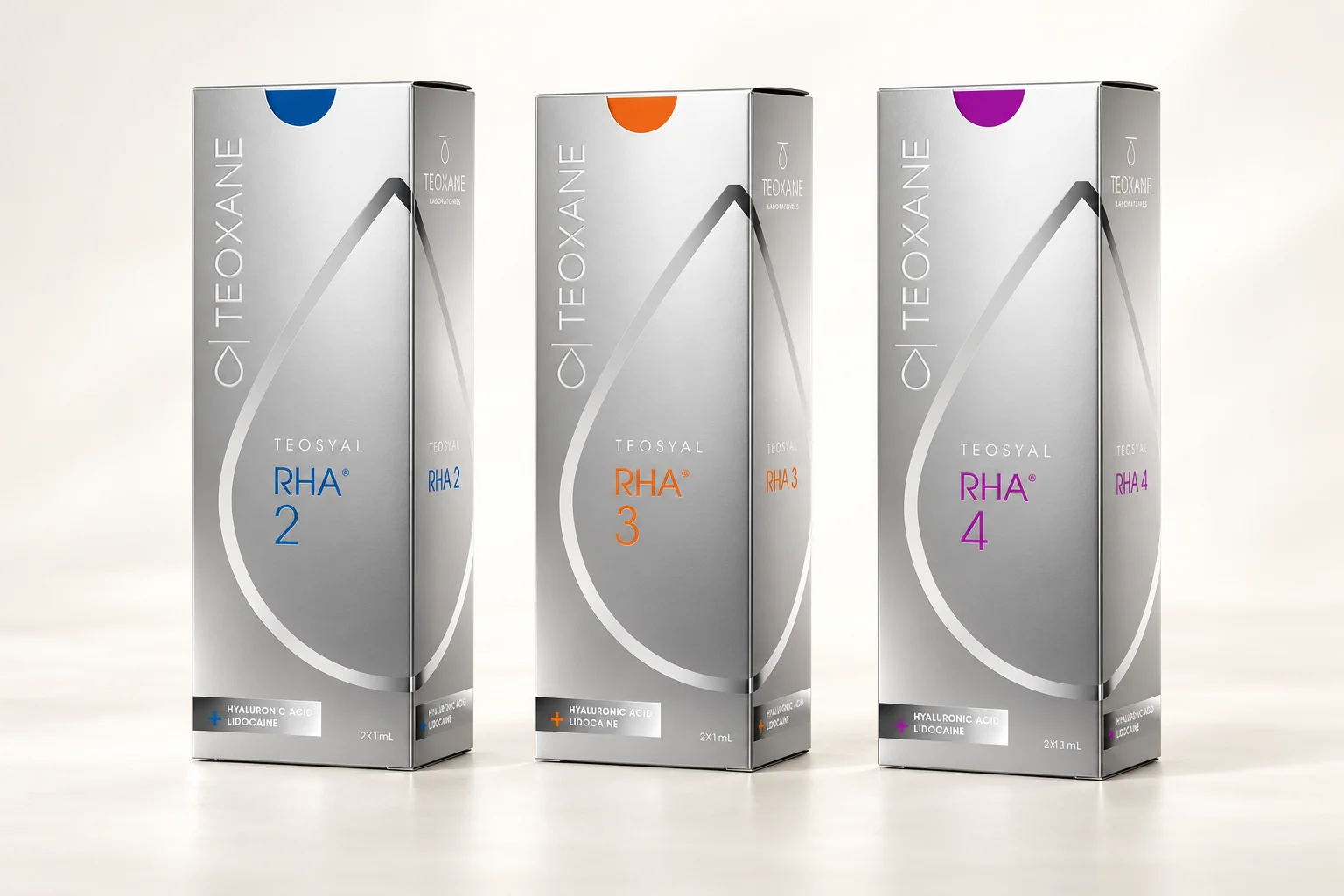
| Product | Approved depth | Approved purpose |
|---|
| RHA 2 | Mid-to-deep dermis | Temporarily improve moderate to severe nasolabial folds, adults 22 and older |
| RHA 3 | Mid-to-deep dermis | Temporarily improve moderate to severe nasolabial folds, adults 22 and older |
| RHA 4 | Deep dermis to superficial subcutaneous tissue | Temporarily improve moderate to severe nasolabial folds, adults 22 and older |
Source: Ministry of Food and Drug Safety (MFDS) medical device register, emedi.mfds.go.kr, checked 23 October 2026.
- Two depth ranges. With these products, a layered plan in one fold uses the deeper range for RHA 4 and the shallower range for RHA 2 or RHA 3.
- One area. Both approvals name the nasolabial folds and no other part of the face.
- Lidocaine. The approvals describe the gels as containing lidocaine, a local anesthetic.
- RHA 2 and RHA 3 share a depth. Teoxane describes its RHA range by two properties, stretch and strength (Teoxane).
- How to check. Ask the clinic for the Korean approval number on the box, then search the register by that number. The records list products by model code rather than by name. The prefix 수허 (suheo) means import approval.
How the RHA gels are made is explained in our article on what an RHA filler is.
Is layering always used, and who decides?
No. Whether a fold is treated at one depth, at several depths, or not with filler at all depends on what is causing it. A Korean review of nasolabial fold anatomy and injection techniques describes three types of fold: those caused mainly by volume loss, by tissue laxity, or by muscle attachments (Yonsei University repository).
Layering also has its own trade-offs. A 2022 letter by Lee and Yang, commenting on a published multilayer technique, points out that the facial artery runs near the nasolabial fold and warns that injecting into multiple layers can cause vascular complications (Lee and Yang, 2022). The Korean review on fold types also stresses that the course of the facial artery varies between people.
At 4ever the Cheongdam, Dr. Younghan Seo looks at the following before deciding on a plan:
- how the fold changes when you talk, smile and relax;
- whether the fold comes mainly from the skin, the fat beside it, or the pull of the muscles;
- the thickness of your skin, since thin skin shows more of what lies beneath it;
What happens at a visit, and what should you plan for if you are visiting from abroad?
A visit usually has three parts: an examination, the treatment if it is chosen, and a follow-up check.
- Examination. Your face is looked at at rest and in motion, and the plan is explained before anything is injected.
- Treatment. If filler is chosen, the product, depth and amount are the ones decided at the examination.
- Follow-up. The clinic checks how the area has settled.
If you are traveling to Korea for treatment, a few details make the trip easier:
- Tell the clinic about your skin in advance. The US FDA advises delaying filler if you have active pimples, a rash or an infection in the area.
- Allow recovery time. Swelling and bruising often settle within days to weeks, so leave a gap before important events or photographs.
- Get the product details in writing. Ask for the product name, the Korean approval number and the lot number from the box.
- Plan the follow-up. Ask when the clinic would like to see you again, and whether photographs can be sent if you have already left Korea.
What are the side effects of layered filler, and what should you watch for?
Layered plans carry the risks of hyaluronic acid fillers in general. The US FDA lists bruising, redness, swelling, pain, tenderness, itching and rash as common, and says many side effects resolve in a few days to weeks. Some side effects can appear weeks, months or even years after injection.
The most serious risk is filler entering a blood vessel. This is rare, but it can cause tissue damage, vision problems or stroke. The course of the blood vessels around the nose and mouth varies from person to person.
| What you notice | What to do |
|---|
| Swelling, bruising or tenderness | Follow the clinic’s written aftercare; tell the clinic if it gets worse instead of better |
| A lump or firm area | Raise it at follow-up; do not press or massage it unless the clinic tells you to |
| Redness or swelling that develops near the injection site after an illness, a vaccination or dental work | Contact the clinic |
| Unusual pain, or skin near the injection site turning white, gray or blue | Contact the clinic immediately |
| Any change in vision, or signs of a stroke | Seek emergency medical care at once |
Before treatment, ask how many injection points the plan uses, and tell the clinic about any medicines you take and any earlier treatment in the same area. Whether a layered plan suits you is a clinical judgment your doctor makes after examining you.
Frequently asked questions
Does nasolabial fold filler hurt?
Discomfort varies from person to person. In Korea, the RHA approvals describe the gels as containing lidocaine, a local anesthetic. If you have ever reacted to a local anesthetic, tell the clinic before the appointment, not on the day.
How long does swelling last after nasolabial fold filler?
Swelling and bruising are among the most common side effects of filler, and many settle within a few days to weeks, as described in the side effects section above. If swelling increases instead of settling, or returns later, contact the clinic.
How long does layered nasolabial fold filler last?
There is no single figure. The Korean approvals describe the improvement as temporary and do not state a duration. A published trial followed people treated with RHA 2, 3 and 4 in the nasolabial folds for 18 months (Rzany et al., Dermatologic Surgery, 2019); that is the length of a study, not a promise for any one person.
Can filler and Botox be done at the same visit?
Some treatment plans around the mouth also include botulinum toxin, which is a medicine rather than a device and is decided separately. The US FDA notes that the safety of fillers used together with neuromodulators such as Botox has not been evaluated in a controlled clinical study. Ask the clinic whether both are planned, and in what order.
Can layered filler be dissolved?
Hyaluronic acid can be broken down with an enzyme called hyaluronidase. Removing filler can involve further injections or other procedures, and these carry their own risks. Whether dissolving is appropriate is a clinical decision, so ask how the clinic handles it before treatment.
This article is general information about a treatment offered at 4ever the Cheongdam. It is not medical advice and does not replace consultation with a doctor who has examined you. Product approvals, regulations, and clinic practices change; please confirm anything that affects a decision with the clinic directly.
Sources: Korean Ministry of Food and Drug Safety, medical device register. Jung GS. Hyaluronic Acid Filler Injection Technique in Multiple Layers of the Nasolabial Fold, PRS Global Open 2020;8(12):e3318. Lee W, Yang EJ. Letter to the editor on “Hyaluronic Acid Filler Injection Technique in Multiple Layers of the Nasolabial Fold“, PRS Global Open 2022;10(6):e4376. Kwon HJ, et al. The Nasolabial Fold: A Micro-Computed Tomography Study, Plastic and Reconstructive Surgery 2020;145(1):71–79. Anatomic variations of the nasolabial fold, Plastic and Reconstructive Surgery 1992;89(2):225–231. Swift A, et al. The Facial Aging Process From the “Inside Out”, Aesthetic Surgery Journal 2021;41(10):1107–1119. Anatomical-Based Diagnosis and Filler Injection Techniques (Yonsei University repository). Rzany B, et al. Dermatologic Surgery 2019;45(10):1304–1314. Teoxane, dermal filler solutions (manufacturer’s description). US Food and Drug Administration, Dermal Fillers (Soft Tissue Fillers).
4ever the Cheongdam
99-23 Cheongdam-dong, Gangnam-gu, Seoul, Korea
서울 강남구 청담동 99-23 (copy this line into Naver Map, Kakao Map, or show it to a taxi driver)
Tel. +82-2-518-7705

A nasolabial fold looks like one line on the surface, but it is shaped by several layers underneath: the skin, fibrous strands, fat, and the muscles you use to smile. Because the fold is more than one layer deep, some treatment plans place filler at two or more depths instead of only along the visible crease, an approach often called multilayering. In Korea, Teoxane’s RHA 2, RHA 3 and RHA 4 are approved to temporarily improve moderate to severe nasolabial folds in adults aged 22 or older, each at a set depth, and those depths are the limits of any layered plan with these products. Whether layering suits your fold is decided at an examination.
What does it mean to treat a nasolabial fold in layers?
It means placing filler at more than one depth in the same fold, rather than along the visible line at a single level. Plastic surgeons have published a description of a hyaluronic acid injection technique in multiple layers of the nasolabial fold (Jung, PRS Global Open, 2020).
A bed is a simple way to picture it. The mattress gives the base support, and a thinner topper smooths what lies on top. In a layered plan, gel placed deeper gives support from below, and gel placed closer to the surface smooths the line itself.
Why is a nasolabial fold more than a line in the skin?
The fold forms where the skin and fat of the cheek meet the muscles around the mouth, and each of those layers changes in its own way. A 1992 anatomical study described the fold as the result of an interaction between the cheek’s skin-and-fat layer and the muscles beneath it, and found the smiling muscles directly responsible for its shape and depth (Plastic and Reconstructive Surgery, 1992).
A Korean micro-CT study looked at the fold in more detail (Kwon et al., Plastic and Reconstructive Surgery, 2020):
A review of facial aging adds the wider picture: aging involves the bone, soft tissue and skin together, and the surface layers depend on the layers beneath them (Swift et al., Aesthetic Surgery Journal, 2021). For how the face changes layer by layer, see our earlier article on facial aging.
Why can a filled fold look different when you smile?
Because the line you see at rest is only part of what moves when you smile. The fibrous strands that tie the cheek fat to the skin, sometimes called the retinacular cutis, hold the skin in place over the fold, and the smiling muscles pull on the same area.
This is one reason a doctor looks at the fold while you talk and smile, not only at rest. How movement shapes filler planning is covered in our article on nasolabial fold filler and movement.
Which depths are RHA 2, RHA 3 and RHA 4 approved for in Korea?
RHA 2 and RHA 3 are approved for the mid-to-deep dermis, and RHA 4 for the deep dermis to the superficial subcutaneous tissue. All three are approved for one purpose: to temporarily improve moderate to severe nasolabial folds in adults aged 22 or older through physical restoration.
Source: Ministry of Food and Drug Safety (MFDS) medical device register, emedi.mfds.go.kr, checked 23 October 2026.
How the RHA gels are made is explained in our article on what an RHA filler is.
Is layering always used, and who decides?
No. Whether a fold is treated at one depth, at several depths, or not with filler at all depends on what is causing it. A Korean review of nasolabial fold anatomy and injection techniques describes three types of fold: those caused mainly by volume loss, by tissue laxity, or by muscle attachments (Yonsei University repository).
Layering also has its own trade-offs. A 2022 letter by Lee and Yang, commenting on a published multilayer technique, points out that the facial artery runs near the nasolabial fold and warns that injecting into multiple layers can cause vascular complications (Lee and Yang, 2022). The Korean review on fold types also stresses that the course of the facial artery varies between people.
At 4ever the Cheongdam, Dr. Younghan Seo looks at the following before deciding on a plan:
What happens at a visit, and what should you plan for if you are visiting from abroad?
A visit usually has three parts: an examination, the treatment if it is chosen, and a follow-up check.
If you are traveling to Korea for treatment, a few details make the trip easier:
What are the side effects of layered filler, and what should you watch for?
Layered plans carry the risks of hyaluronic acid fillers in general. The US FDA lists bruising, redness, swelling, pain, tenderness, itching and rash as common, and says many side effects resolve in a few days to weeks. Some side effects can appear weeks, months or even years after injection.
The most serious risk is filler entering a blood vessel. This is rare, but it can cause tissue damage, vision problems or stroke. The course of the blood vessels around the nose and mouth varies from person to person.
Before treatment, ask how many injection points the plan uses, and tell the clinic about any medicines you take and any earlier treatment in the same area. Whether a layered plan suits you is a clinical judgment your doctor makes after examining you.
Frequently asked questions
Does nasolabial fold filler hurt?
Discomfort varies from person to person. In Korea, the RHA approvals describe the gels as containing lidocaine, a local anesthetic. If you have ever reacted to a local anesthetic, tell the clinic before the appointment, not on the day.
How long does swelling last after nasolabial fold filler?
Swelling and bruising are among the most common side effects of filler, and many settle within a few days to weeks, as described in the side effects section above. If swelling increases instead of settling, or returns later, contact the clinic.
How long does layered nasolabial fold filler last?
There is no single figure. The Korean approvals describe the improvement as temporary and do not state a duration. A published trial followed people treated with RHA 2, 3 and 4 in the nasolabial folds for 18 months (Rzany et al., Dermatologic Surgery, 2019); that is the length of a study, not a promise for any one person.
Can filler and Botox be done at the same visit?
Some treatment plans around the mouth also include botulinum toxin, which is a medicine rather than a device and is decided separately. The US FDA notes that the safety of fillers used together with neuromodulators such as Botox has not been evaluated in a controlled clinical study. Ask the clinic whether both are planned, and in what order.
Can layered filler be dissolved?
Hyaluronic acid can be broken down with an enzyme called hyaluronidase. Removing filler can involve further injections or other procedures, and these carry their own risks. Whether dissolving is appropriate is a clinical decision, so ask how the clinic handles it before treatment.
This article is general information about a treatment offered at 4ever the Cheongdam. It is not medical advice and does not replace consultation with a doctor who has examined you. Product approvals, regulations, and clinic practices change; please confirm anything that affects a decision with the clinic directly.
Sources: Korean Ministry of Food and Drug Safety, medical device register. Jung GS. Hyaluronic Acid Filler Injection Technique in Multiple Layers of the Nasolabial Fold, PRS Global Open 2020;8(12):e3318. Lee W, Yang EJ. Letter to the editor on “Hyaluronic Acid Filler Injection Technique in Multiple Layers of the Nasolabial Fold“, PRS Global Open 2022;10(6):e4376. Kwon HJ, et al. The Nasolabial Fold: A Micro-Computed Tomography Study, Plastic and Reconstructive Surgery 2020;145(1):71–79. Anatomic variations of the nasolabial fold, Plastic and Reconstructive Surgery 1992;89(2):225–231. Swift A, et al. The Facial Aging Process From the “Inside Out”, Aesthetic Surgery Journal 2021;41(10):1107–1119. Anatomical-Based Diagnosis and Filler Injection Techniques (Yonsei University repository). Rzany B, et al. Dermatologic Surgery 2019;45(10):1304–1314. Teoxane, dermal filler solutions (manufacturer’s description). US Food and Drug Administration, Dermal Fillers (Soft Tissue Fillers).
4ever the Cheongdam
99-23 Cheongdam-dong, Gangnam-gu, Seoul, Korea
서울 강남구 청담동 99-23 (copy this line into Naver Map, Kakao Map, or show it to a taxi driver)
Tel. +82-2-518-7705