The skin around the mouth moves more than almost any other part of the face, because you use it to talk, eat, drink and smile all day. That is why a filler placed in a nasolabial fold, the line from the side of the nose to the corner of the mouth, is planned around how the area moves and not only around how it looks at rest. In Korea, the Ministry of Food and Drug Safety (MFDS) has approved Teoxane’s RHA 2, RHA 3 and RHA 4 for one use: to temporarily improve moderate to severe nasolabial folds in adults aged 22 or older. Which product, depth and amount are used for you, if any, is decided at an examination.
Why do lines around the mouth behave differently?
The mouth sits in the middle of a ring of muscles that pull in several directions, and the skin over them folds and stretches many times a day. Lines here change shape with every expression.
- Constant movement. Talking, chewing and smiling all move the same area, so a line can look shallow at rest and deep when you smile.
- Several layers involved. A fold can reflect the skin itself, the fat beneath it, and the support from the cheek above.
- Changes from above. As the cheek loses some volume and support with age, more tissue can sit over the fold, which deepens it from above.
How the layers of the face change with age is explained in an earlier article on facial aging.
Which lines around the mouth are people usually asking about?
Three kinds of lines come up most often, and they are not the same problem. Naming them correctly helps at the consultation.
| Line | Where it is | What it often reflects |
|---|
| Nasolabial fold | From the side of the nose to the corner of the mouth | Where cheek tissue meets the area around the mouth; deepens with smiling |
| Marionette line | From the corner of the mouth down toward the chin | Changes in support around the lower face and the corners of the mouth |
| Lines on the lips | Fine vertical lines on and above the lips | Repeated lip movement and changes in the skin itself |
This article focuses on nasolabial folds, because that is the area the Korean approvals for the RHA fillers name. Marionette lines and lip lines are different questions, and what may be used for them is a separate discussion at the consultation.
What is considered when filler is used in an area that moves?
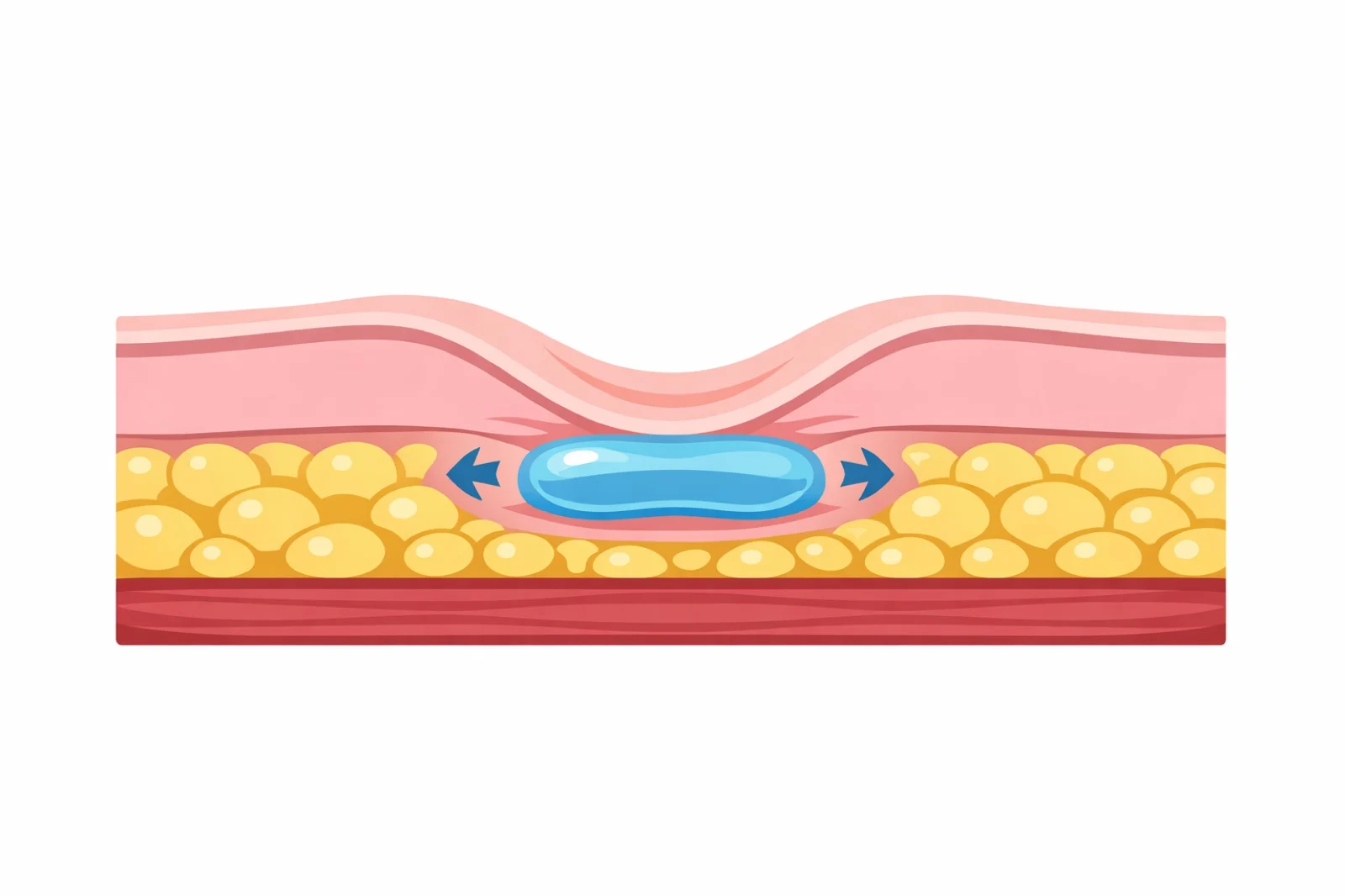
A filler in the nasolabial area has to sit in tissue that stretches and compresses all day. The doctor is weighing the gel, the depth and the amount against how your face moves.
- How the gel behaves under movement. Some gels are firmer and hold shape; others stretch more and recover. Which behavior suits a fold depends on how much that fold moves.
- Depth. The Korean approvals set the depth for each RHA product, from the mid dermis down to the tissue just beneath the skin.
- Amount. More filler is not the same as more correction; too much in a moving area can look unnatural when you talk or smile.
- The cause of the fold. If the fold is deepened mainly by changes in the cheek above, filling the line alone may not change what you see.
- Your expressions. The doctor will usually look at your face at rest and while you talk and smile, not only lying still.
Where filler is placed can matter as much as which filler is used; see what a retaining ligament filler means.
How does Teoxane describe its RHA fillers, and what are they approved for in Korea?
Teoxane, a Swiss manufacturer, designs its RHA gels around facial movement. It describes fillers as being subjected to the movements and pressures of talking, eating and expressing emotions, and it describes its RHA range by two properties, stretch and strength (Teoxane).
| Product | Korean approval no. | Approved area in Korea | Approved depth |
|---|
| RHA 2 and RHA 3 | 수허 19-48 | Moderate to severe nasolabial folds, adults 22 and older | Mid-to-deep dermis |
| RHA 4 | 수허 19-49 | Moderate to severe nasolabial folds, adults 22 and older | Deep dermis to superficial subcutaneous tissue |
- The approved purpose. Both approvals describe lidocaine-containing cross-linked hyaluronic acid used to temporarily improve the folds through physical restoration.
- One area. The approvals name the nasolabial folds and no other part of the face.
- Model codes. The register lists these products by model code, so the link to the RHA names rests on the manufacturer, the importer and the injection depth.
- At this clinic. Dr. Younghan Seo works with Teoxane RHA fillers, as described on his profile page.
How the gels are made and what the US approval says are covered in an earlier article on RHA fillers.
What does the examination look at, and what should a visitor from abroad plan for?
The doctor is deciding whether the fold is a line that filler is designed to address, or a sign of a change elsewhere. A consultation is likely to cover the points below.
- Your face in motion. How the fold changes when you talk, smile and relax.
- The cheek above. Whether loss of support in the mid-face is deepening the fold.
- Skin thickness. Thin skin shows more of what is placed beneath it.
- Earlier treatment. Fillers, threads or energy-based treatments in the area, and when they were done.
- Health history. Medicines that affect bleeding, any allergy to local anesthetics, and any history of cold sores around the mouth.
Whether a filler suits your nasolabial folds is a clinical judgment your doctor makes after examining you.
If you are visiting from abroad, a few details make follow-up easier once you are home.
- Get the product details in writing. Ask for the product name, the Korean approval number and the lot number from the box.
- Allow a few days. Swelling around the mouth can affect how you talk and eat at first; avoid flying straight after treatment if you can.
- Arrange follow-up. Ask when the clinic would like to see you again, and whether photographs can be sent if you have left Korea.
What are the side effects, and what should you watch for?
Bruising, redness, swelling, pain, tenderness, itching and rash at the injection site are commonly reported after dermal fillers (US FDA). The area around the nose and mouth has blood vessels close to the surface, so the rare but serious risk of filler entering a blood vessel matters here. The clinic’s written instructions take precedence.
| What you notice | What to do |
|---|
| Swelling, bruising, tenderness | Follow the aftercare sheet; tell the clinic if it increases instead of settling |
| A lump or firm spot | Mention it at follow-up; do not press or massage unless the clinic tells you to |
| A cold sore near the treated area | Contact the clinic |
| Unusual pain, or skin that turns white, gray or blue near the injection site | Contact the clinic immediately; this can mean a blocked blood vessel |
| Any change in vision, or signs of a stroke | Seek emergency medical care at once |
The US FDA advises seeking immediate medical attention for unusual pain, vision changes, a white, gray or blue appearance of skin near the injection site, or signs of a stroke during or shortly after the procedure. Because the RHA gels contain lidocaine, tell the clinic before treatment if you have ever reacted to a local anesthetic.
FAQ
Is a nasolabial fold a wrinkle?
It is usually described as a fold, not a wrinkle. It forms where the cheek meets the area around the mouth, and it is present to some degree in most faces, even young ones.
Why can a fold look different when I smile?
Smiling pushes cheek tissue up and toward the fold, so the fold deepens. A line that is shallow at rest can look much deeper in motion, which is why the doctor looks at both.
Are Teoxane RHA fillers approved in Korea for marionette lines?
No. The Korean approvals that match RHA 2, RHA 3 and RHA 4 name moderate to severe nasolabial folds only. Marionette lines are a separate discussion at the consultation.
Which RHA product is used for a nasolabial fold?
All three are approved in Korea for nasolabial folds, at different depths. Which one, if any, is used depends on your skin and tissue and is decided after examination.
Will filler change how my face moves?
A filler does not change how the muscles around the mouth work. How it looks and feels when you talk and smile depends on the product, the depth and the amount, which is why movement is part of the examination.
How can I check the approval for the product used on me?
Ask the clinic for the approval number on the box and search it on the Korean device register at emedi.mfds.go.kr. A search by the name RHA returns no results, because the records use model codes.
This article is general information about a treatment offered at 4ever the Cheongdam. It is not medical advice and does not replace consultation with a doctor who has examined you. Product approvals, regulations, and clinic practices change; please confirm anything that affects a decision with the clinic directly.
Sources: Korean Ministry of Food and Drug Safety, medical device register, emedi.mfds.go.kr (records 수허 19-48 and 수허 19-49; retrieved 2 October 2026). Teoxane, dermal filler solutions (manufacturer’s description). US Food and Drug Administration, Dermal Fillers (Soft Tissue Fillers).
4ever the Cheongdam
99-23 Cheongdam-dong, Gangnam-gu, Seoul, Korea
서울 강남구 청담동 99-23 (copy this line into Naver Map, Kakao Map, or show it to a taxi driver)
Tel. +82-2-518-7705

The skin around the mouth moves more than almost any other part of the face, because you use it to talk, eat, drink and smile all day. That is why a filler placed in a nasolabial fold, the line from the side of the nose to the corner of the mouth, is planned around how the area moves and not only around how it looks at rest. In Korea, the Ministry of Food and Drug Safety (MFDS) has approved Teoxane’s RHA 2, RHA 3 and RHA 4 for one use: to temporarily improve moderate to severe nasolabial folds in adults aged 22 or older. Which product, depth and amount are used for you, if any, is decided at an examination.
Why do lines around the mouth behave differently?
The mouth sits in the middle of a ring of muscles that pull in several directions, and the skin over them folds and stretches many times a day. Lines here change shape with every expression.
How the layers of the face change with age is explained in an earlier article on facial aging.
Which lines around the mouth are people usually asking about?
Three kinds of lines come up most often, and they are not the same problem. Naming them correctly helps at the consultation.
This article focuses on nasolabial folds, because that is the area the Korean approvals for the RHA fillers name. Marionette lines and lip lines are different questions, and what may be used for them is a separate discussion at the consultation.
What is considered when filler is used in an area that moves?
A filler in the nasolabial area has to sit in tissue that stretches and compresses all day. The doctor is weighing the gel, the depth and the amount against how your face moves.
Where filler is placed can matter as much as which filler is used; see what a retaining ligament filler means.
How does Teoxane describe its RHA fillers, and what are they approved for in Korea?
Teoxane, a Swiss manufacturer, designs its RHA gels around facial movement. It describes fillers as being subjected to the movements and pressures of talking, eating and expressing emotions, and it describes its RHA range by two properties, stretch and strength (Teoxane).
How the gels are made and what the US approval says are covered in an earlier article on RHA fillers.
What does the examination look at, and what should a visitor from abroad plan for?
The doctor is deciding whether the fold is a line that filler is designed to address, or a sign of a change elsewhere. A consultation is likely to cover the points below.
Whether a filler suits your nasolabial folds is a clinical judgment your doctor makes after examining you.
If you are visiting from abroad, a few details make follow-up easier once you are home.
What are the side effects, and what should you watch for?
Bruising, redness, swelling, pain, tenderness, itching and rash at the injection site are commonly reported after dermal fillers (US FDA). The area around the nose and mouth has blood vessels close to the surface, so the rare but serious risk of filler entering a blood vessel matters here. The clinic’s written instructions take precedence.
The US FDA advises seeking immediate medical attention for unusual pain, vision changes, a white, gray or blue appearance of skin near the injection site, or signs of a stroke during or shortly after the procedure. Because the RHA gels contain lidocaine, tell the clinic before treatment if you have ever reacted to a local anesthetic.
FAQ
Is a nasolabial fold a wrinkle?
It is usually described as a fold, not a wrinkle. It forms where the cheek meets the area around the mouth, and it is present to some degree in most faces, even young ones.
Why can a fold look different when I smile?
Smiling pushes cheek tissue up and toward the fold, so the fold deepens. A line that is shallow at rest can look much deeper in motion, which is why the doctor looks at both.
Are Teoxane RHA fillers approved in Korea for marionette lines?
No. The Korean approvals that match RHA 2, RHA 3 and RHA 4 name moderate to severe nasolabial folds only. Marionette lines are a separate discussion at the consultation.
Which RHA product is used for a nasolabial fold?
All three are approved in Korea for nasolabial folds, at different depths. Which one, if any, is used depends on your skin and tissue and is decided after examination.
Will filler change how my face moves?
A filler does not change how the muscles around the mouth work. How it looks and feels when you talk and smile depends on the product, the depth and the amount, which is why movement is part of the examination.
How can I check the approval for the product used on me?
Ask the clinic for the approval number on the box and search it on the Korean device register at emedi.mfds.go.kr. A search by the name RHA returns no results, because the records use model codes.
This article is general information about a treatment offered at 4ever the Cheongdam. It is not medical advice and does not replace consultation with a doctor who has examined you. Product approvals, regulations, and clinic practices change; please confirm anything that affects a decision with the clinic directly.
Sources: Korean Ministry of Food and Drug Safety, medical device register, emedi.mfds.go.kr (records 수허 19-48 and 수허 19-49; retrieved 2 October 2026). Teoxane, dermal filler solutions (manufacturer’s description). US Food and Drug Administration, Dermal Fillers (Soft Tissue Fillers).
4ever the Cheongdam
99-23 Cheongdam-dong, Gangnam-gu, Seoul, Korea
서울 강남구 청담동 99-23 (copy this line into Naver Map, Kakao Map, or show it to a taxi driver)
Tel. +82-2-518-7705