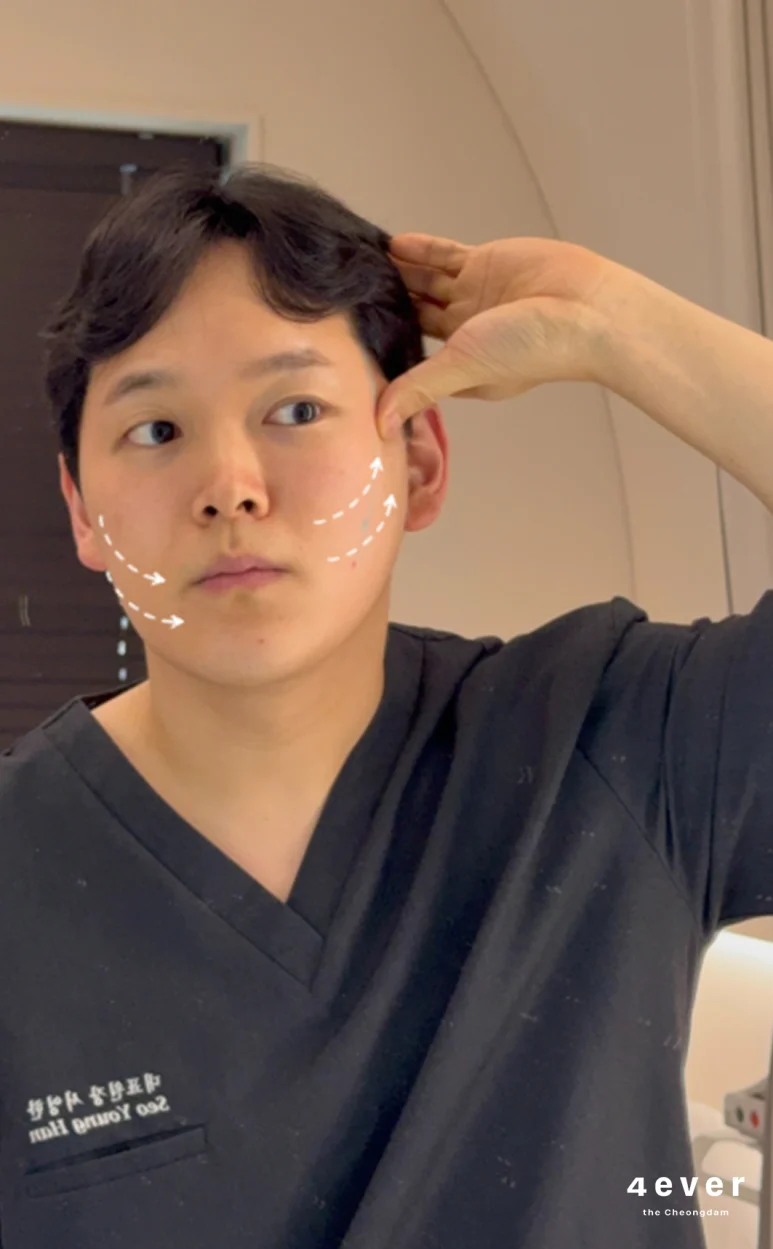
Cheek descent rarely presents as a single isolated change.
As the deep fat compartments shift downward and the retaining ligaments that support mid-face structure weaken, the entire facial contour reorganizes.
The result is a face that looks flatter in the center and heavier in the lower third, with nasolabial folds that deepen not because of skin wrinkling but because the tissue above them has descended.
At 4ever Cheongdam Clinic, Dr. Younghan Seo explains why treating the visible fold without addressing the underlying structural change produces incomplete results, and how the heart-line approach restores the contour that actually determines youthful facial impression.
Key Takeaways
Nasolabial folds deepen primarily because mid-face tissue descends, not because the skin wrinkles in isolation.
Treating the fold without addressing the descent leaves the structural cause intact.
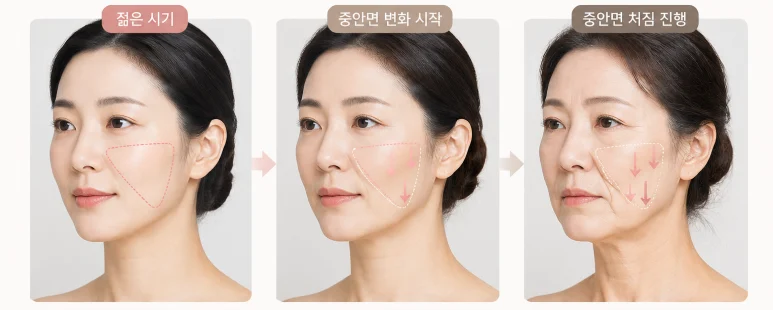
The heart-line contour refers to volume that rises from the anterior cheekbone to the mid-cheek and tapers naturally toward the jawline. When this curve descends, the face reads as inverted and heavier below.
Ellansé approaches mid-face descent through collagen stimulation rather than direct volumization, reinforcing the deep structural support that has weakened rather than adding weight to compromised tissue.
The Ellansé Heartline Solution uses Lifting Code and Contouring Code protocols to design the full contour flow rather than filling individual hollows in isolation.
When descent is more advanced, Silhouette Soft thread lifting can reposition the descended fat layer itself, with Ellansé providing the deep structural base and energy-based devices such as Ulthera or Thermage addressing elasticity in the overlying skin.

Why Mid-Face Descent Changes the Entire Impression
Facial aging at the mid-face level involves several simultaneous changes: volume loss in the anterior cheek, downward migration of the deep fat compartments, and progressive weakening of the retaining ligaments that anchor facial tissue to the underlying bony structure.
As this process advances, the anterior cheek loses its three-dimensional projection, the shadow around the mouth deepens, and the lower face takes on a heavier appearance relative to the upper and mid-face.
The nasolabial fold becomes more visible not because the skin has developed a new crease but because the tissue that previously sat above it has shifted downward, creating a ledge.
Adding surface volume to the fold itself addresses the appearance at that specific point but does not affect the distribution of tissue weight that produced it. In some cases, adding volume to an area where tissue has already descended adds to the heaviness rather than correcting it.
What the Heart-Line Contour Actually Means
A youthful mid-face is not simply a full one.
The specific quality that reads as young is a smooth curve that rises from the anterior cheekbone, peaks at the mid-cheek, and tapers gently toward the jawline.
This curve creates a face that appears light at the center and defined at the periphery.
When mid-face descent occurs, this curve inverts: volume accumulates at the lower cheek and jowl while the anterior cheek flattens.
The face reads as heavier below and flatter above, which is the structural basis of what most patients describe as looking tired or older without being able to identify exactly why.
Restoring the heart-line means reestablishing this curve, which requires addressing where the volume sits and how the tissue is supported, not simply how much volume is present.
Ellansé Heartline Solution: How It Works
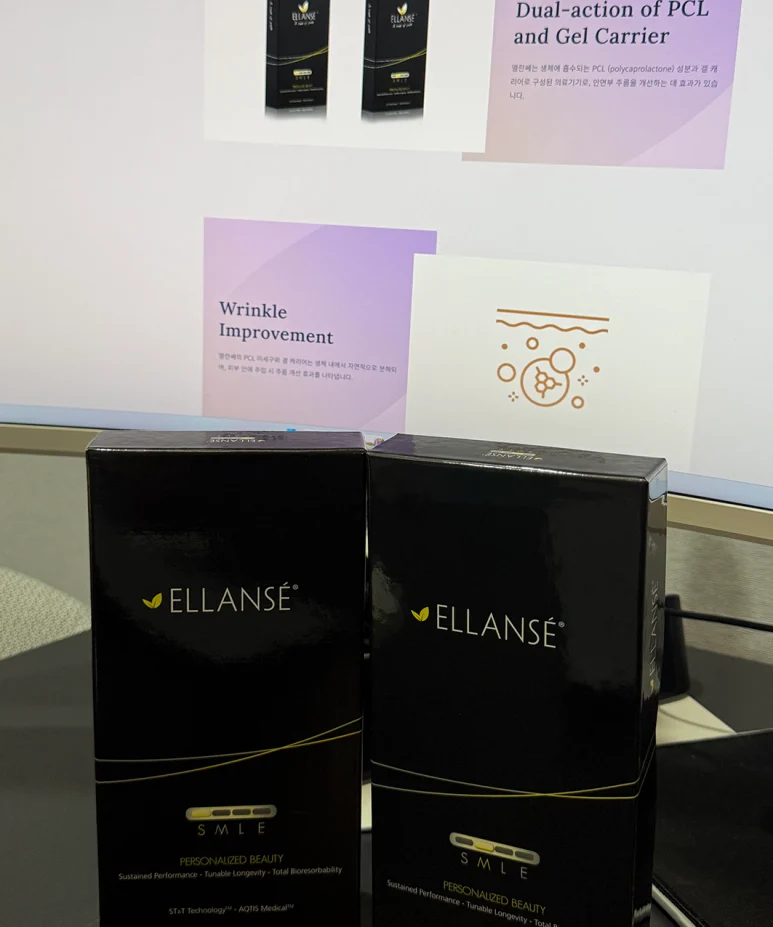
Ellansé is a PCL-based biostimulator.
The mechanism differs from standard HA filler in a clinically meaningful way: rather than adding volume through the injected material itself, Ellansé delivers PCL microspheres that stimulate the surrounding tissue to produce new collagen over time.
The volumetric effect develops progressively as this collagen accumulates, and the result feels and behaves like the patient’s own tissue because it largely is.
For mid-face descent specifically, this mechanism addresses the correct problem.
When the deep structural support has weakened, adding external volume to the surface adds weight to tissue that is already insufficiently supported.
Ellansé reinforces the deep support layer first, creating a foundation that the overlying tissue can rest on rather than further loading a compromised structure.
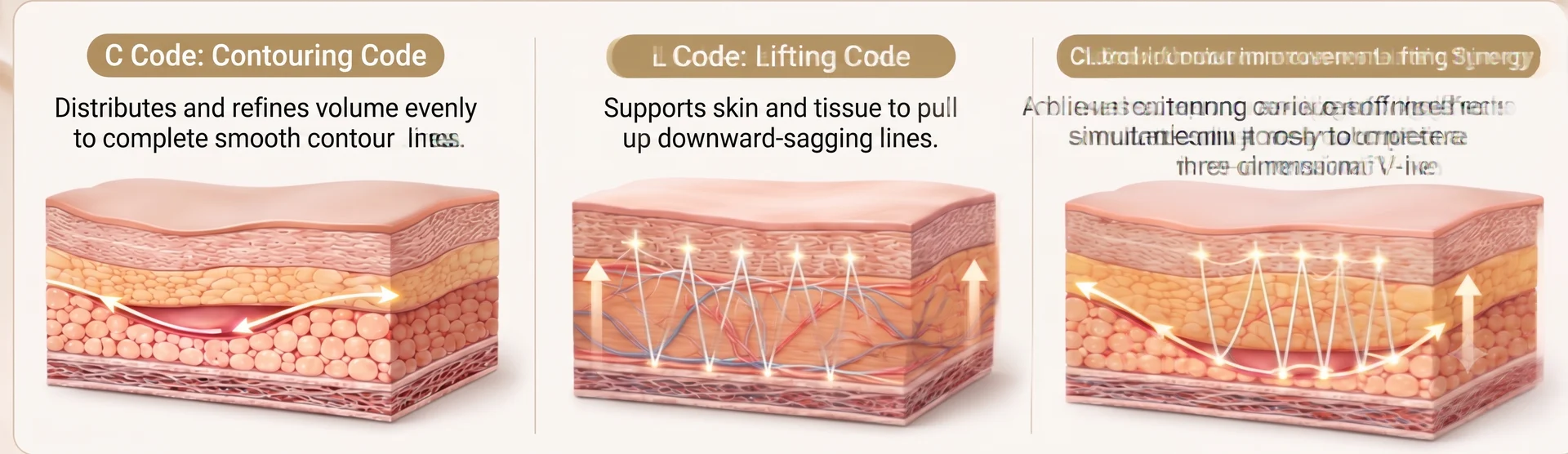
The Ellansé Heartline Solution protocol uses two design frameworks:
Lifting Code addresses deep structural support, working at the layer where the retaining ligaments and deep fat compartments have weakened.
Contouring Code refines the surface contour and the transitions between facial zones, producing the smooth curve and soft connectivity that characterizes the heart-line impression.
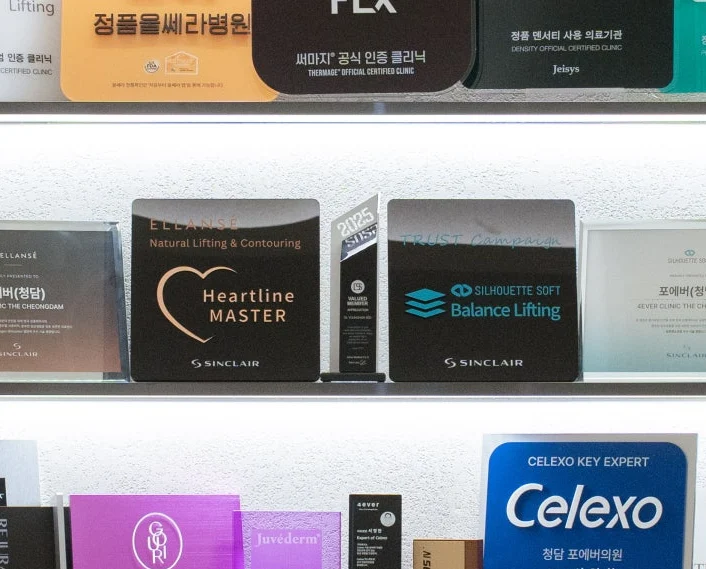
4ever Cheongdam Clinic is designated as an Ellansé Heartline Master Center, one of thirty clinics nationwide to hold this designation.
Dr. Seo is among the highest-volume Ellansé users within the Cheongdam-designated centers.
When Silhouette Soft Is Added to the Protocol
Ellansé is most effective when the primary issue is structural weakening of the deep support layer.
When descent is more advanced and the fat compartments themselves have migrated significantly downward, structural reinforcement alone may not fully reposition the tissue.
In these cases, Silhouette Soft thread lifting is combined with Ellansé to physically reposition the descended tissue rather than simply supporting it in its current location.
Ellansé establishes the deep structural base; Silhouette Soft redirects the surface tissue toward its original position.
When skin elasticity is also a concern alongside descent and structural support, Ulthera or Thermage can be added to address the overlying skin.
Each modality works at a different tissue depth and serves a different function: Ulthera targets the SMAS layer, Thermage remodels the full dermis, Silhouette Soft repositions the mid-layer tissue, and Ellansé reinforces the deep foundation.
This layered approach is what allows the overall result to look natural rather than corrected in one place and untouched everywhere else.
Patients who have had this combination frequently report that the improvement is visible but not locatable: the face looks lighter and more defined without any single area appearing obviously treated.
Frequently Asked Questions
Q. I’ve had filler before and my face looks bigger, not better. What went wrong?
A. This is a common presentation. When filler is placed in a face where mid-face descent is the primary issue, adding volume to the area of apparent hollowing adds weight to tissue that has already moved downward. The face becomes fuller but not higher, which reads as larger rather than more youthful. Correcting this requires understanding which layer has changed and why, not simply deciding where to add more volume.
Q. How is Ellansé different from just getting more filler?
A. Standard HA fillers add immediate volume through the injected gel. Ellansé stimulates the tissue to build its own collagen, producing a result that develops over weeks to months and integrates with the surrounding anatomy. The effect cannot be dissolved after injection, which is why the initial design and dosage decisions are more consequential than with reversible fillers.
Q. How long do Ellansé results last in the mid-face?
A. Results develop over two to four months and are maintained for one to two years or longer depending on the formulation selected and individual tissue response. Because the result is built from collagen the body generates, it tends to fade more gradually and naturally than volume that simply resorbs.
Q. Will I look obviously treated?
A. The heart-line approach is specifically designed to avoid localized overcorrection. By addressing contour flow and connectivity across the full mid-face rather than targeting individual hollows, the result integrates with the natural facial structure. Patients tend to be noticed as looking well-rested or younger rather than as having had a specific procedure.
Q. How do I know whether I need Ellansé alone or a combination with Silhouette Soft?
A. The key variable is how much the fat compartments have actually descended versus how much the deep support structure has simply weakened. When descent is early to moderate and the tissue is still relatively well-positioned, Ellansé alone is often sufficient. When descent is more advanced and the tissue has moved significantly, thread repositioning through Silhouette Soft addresses the displacement that structural reinforcement alone cannot correct. This assessment is made at consultation based on facial examination.
Ready to discuss a treatment plan tailored to your skin?
4ever Cheongdam Clinic offers one-to-one consultations with Dr. Younghan Seo.
Book Your Consultation

Cheek descent rarely presents as a single isolated change.
As the deep fat compartments shift downward and the retaining ligaments that support mid-face structure weaken, the entire facial contour reorganizes.
The result is a face that looks flatter in the center and heavier in the lower third, with nasolabial folds that deepen not because of skin wrinkling but because the tissue above them has descended.
At 4ever Cheongdam Clinic, Dr. Younghan Seo explains why treating the visible fold without addressing the underlying structural change produces incomplete results, and how the heart-line approach restores the contour that actually determines youthful facial impression.
Key Takeaways
Nasolabial folds deepen primarily because mid-face tissue descends, not because the skin wrinkles in isolation.
Treating the fold without addressing the descent leaves the structural cause intact.
The heart-line contour refers to volume that rises from the anterior cheekbone to the mid-cheek and tapers naturally toward the jawline. When this curve descends, the face reads as inverted and heavier below.
Ellansé approaches mid-face descent through collagen stimulation rather than direct volumization, reinforcing the deep structural support that has weakened rather than adding weight to compromised tissue.
The Ellansé Heartline Solution uses Lifting Code and Contouring Code protocols to design the full contour flow rather than filling individual hollows in isolation.
When descent is more advanced, Silhouette Soft thread lifting can reposition the descended fat layer itself, with Ellansé providing the deep structural base and energy-based devices such as Ulthera or Thermage addressing elasticity in the overlying skin.
Why Mid-Face Descent Changes the Entire Impression
Facial aging at the mid-face level involves several simultaneous changes: volume loss in the anterior cheek, downward migration of the deep fat compartments, and progressive weakening of the retaining ligaments that anchor facial tissue to the underlying bony structure.
As this process advances, the anterior cheek loses its three-dimensional projection, the shadow around the mouth deepens, and the lower face takes on a heavier appearance relative to the upper and mid-face.
The nasolabial fold becomes more visible not because the skin has developed a new crease but because the tissue that previously sat above it has shifted downward, creating a ledge.
Adding surface volume to the fold itself addresses the appearance at that specific point but does not affect the distribution of tissue weight that produced it. In some cases, adding volume to an area where tissue has already descended adds to the heaviness rather than correcting it.
What the Heart-Line Contour Actually Means
A youthful mid-face is not simply a full one.
The specific quality that reads as young is a smooth curve that rises from the anterior cheekbone, peaks at the mid-cheek, and tapers gently toward the jawline.
This curve creates a face that appears light at the center and defined at the periphery.
When mid-face descent occurs, this curve inverts: volume accumulates at the lower cheek and jowl while the anterior cheek flattens.
The face reads as heavier below and flatter above, which is the structural basis of what most patients describe as looking tired or older without being able to identify exactly why.
Restoring the heart-line means reestablishing this curve, which requires addressing where the volume sits and how the tissue is supported, not simply how much volume is present.
Ellansé Heartline Solution: How It Works
Ellansé is a PCL-based biostimulator.
The mechanism differs from standard HA filler in a clinically meaningful way: rather than adding volume through the injected material itself, Ellansé delivers PCL microspheres that stimulate the surrounding tissue to produce new collagen over time.
The volumetric effect develops progressively as this collagen accumulates, and the result feels and behaves like the patient’s own tissue because it largely is.
For mid-face descent specifically, this mechanism addresses the correct problem.
When the deep structural support has weakened, adding external volume to the surface adds weight to tissue that is already insufficiently supported.
Ellansé reinforces the deep support layer first, creating a foundation that the overlying tissue can rest on rather than further loading a compromised structure.
The Ellansé Heartline Solution protocol uses two design frameworks:
Lifting Code addresses deep structural support, working at the layer where the retaining ligaments and deep fat compartments have weakened.
Contouring Code refines the surface contour and the transitions between facial zones, producing the smooth curve and soft connectivity that characterizes the heart-line impression.
4ever Cheongdam Clinic is designated as an Ellansé Heartline Master Center, one of thirty clinics nationwide to hold this designation.
Dr. Seo is among the highest-volume Ellansé users within the Cheongdam-designated centers.
When Silhouette Soft Is Added to the Protocol
Ellansé is most effective when the primary issue is structural weakening of the deep support layer.
When descent is more advanced and the fat compartments themselves have migrated significantly downward, structural reinforcement alone may not fully reposition the tissue.
In these cases, Silhouette Soft thread lifting is combined with Ellansé to physically reposition the descended tissue rather than simply supporting it in its current location.
Ellansé establishes the deep structural base; Silhouette Soft redirects the surface tissue toward its original position.
When skin elasticity is also a concern alongside descent and structural support, Ulthera or Thermage can be added to address the overlying skin.
Each modality works at a different tissue depth and serves a different function: Ulthera targets the SMAS layer, Thermage remodels the full dermis, Silhouette Soft repositions the mid-layer tissue, and Ellansé reinforces the deep foundation.
This layered approach is what allows the overall result to look natural rather than corrected in one place and untouched everywhere else.
Patients who have had this combination frequently report that the improvement is visible but not locatable: the face looks lighter and more defined without any single area appearing obviously treated.
Frequently Asked Questions
Q. I’ve had filler before and my face looks bigger, not better. What went wrong?
A. This is a common presentation. When filler is placed in a face where mid-face descent is the primary issue, adding volume to the area of apparent hollowing adds weight to tissue that has already moved downward. The face becomes fuller but not higher, which reads as larger rather than more youthful. Correcting this requires understanding which layer has changed and why, not simply deciding where to add more volume.
Q. How is Ellansé different from just getting more filler?
A. Standard HA fillers add immediate volume through the injected gel. Ellansé stimulates the tissue to build its own collagen, producing a result that develops over weeks to months and integrates with the surrounding anatomy. The effect cannot be dissolved after injection, which is why the initial design and dosage decisions are more consequential than with reversible fillers.
Q. How long do Ellansé results last in the mid-face?
A. Results develop over two to four months and are maintained for one to two years or longer depending on the formulation selected and individual tissue response. Because the result is built from collagen the body generates, it tends to fade more gradually and naturally than volume that simply resorbs.
Q. Will I look obviously treated?
A. The heart-line approach is specifically designed to avoid localized overcorrection. By addressing contour flow and connectivity across the full mid-face rather than targeting individual hollows, the result integrates with the natural facial structure. Patients tend to be noticed as looking well-rested or younger rather than as having had a specific procedure.
Q. How do I know whether I need Ellansé alone or a combination with Silhouette Soft?
A. The key variable is how much the fat compartments have actually descended versus how much the deep support structure has simply weakened. When descent is early to moderate and the tissue is still relatively well-positioned, Ellansé alone is often sufficient. When descent is more advanced and the tissue has moved significantly, thread repositioning through Silhouette Soft addresses the displacement that structural reinforcement alone cannot correct. This assessment is made at consultation based on facial examination.
Ready to discuss a treatment plan tailored to your skin?
4ever Cheongdam Clinic offers one-to-one consultations with Dr. Younghan Seo.
Book Your Consultation